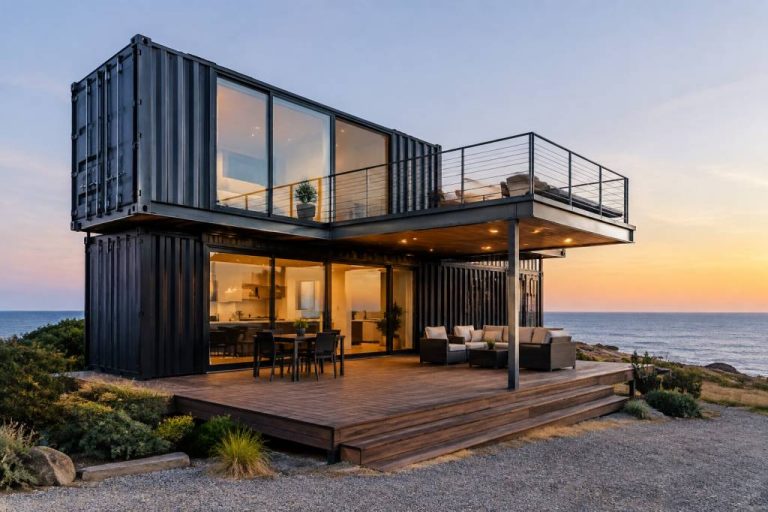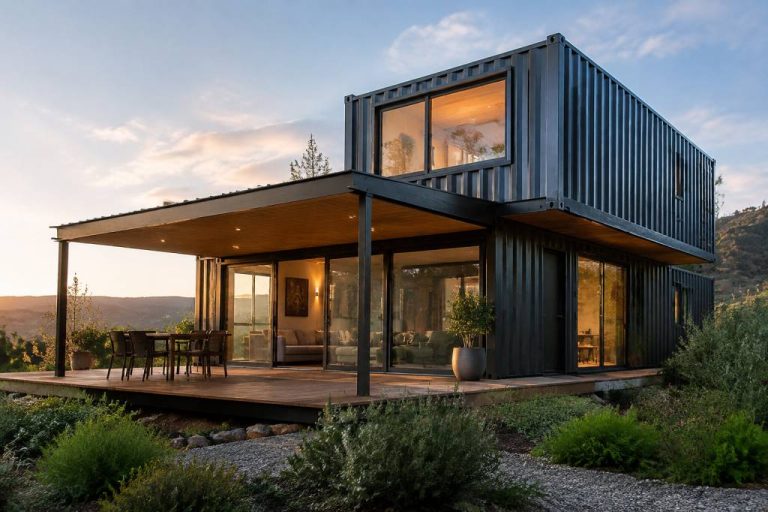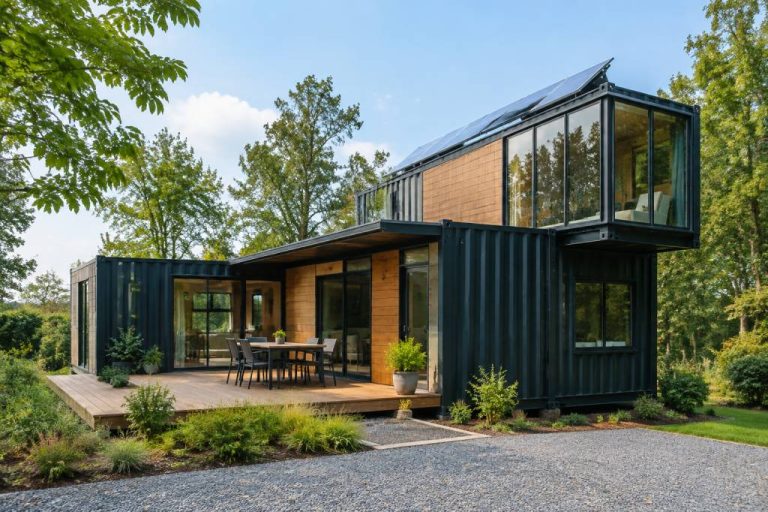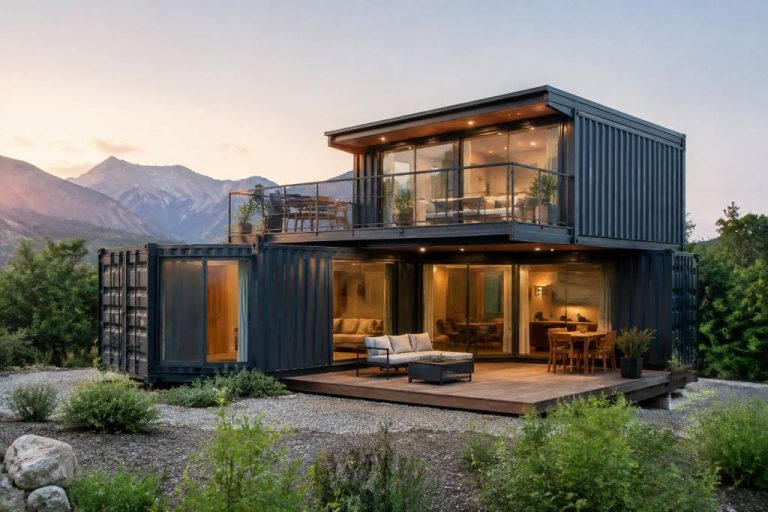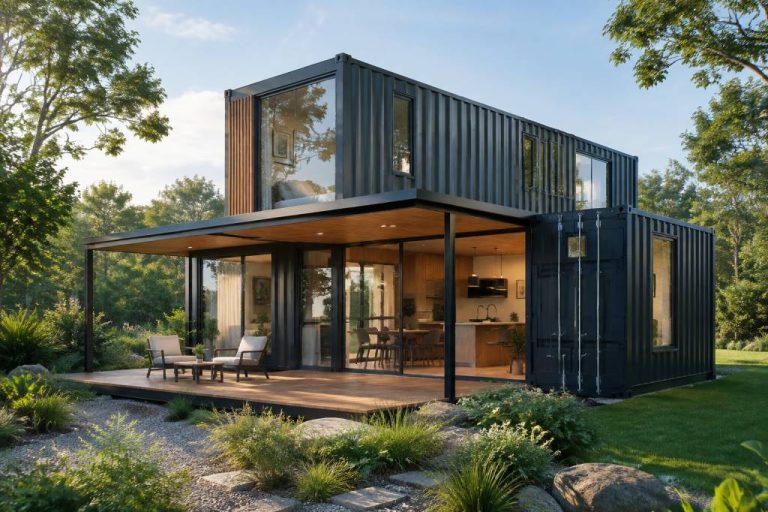

Circular economy principles applied to container construction and interior design
Turning a used shipping container into a home or workspace is already a form of recycling. But if we stop there, we are missing most of the potential. Applying circular economy principles to container construction and interior design means thinking beyond “reuse” and designing every layer of the project so it can be repaired, adapted, dismantled and revalorised.
In other words: how do you build a container house that will not end, unavoidably, à la benne in 20 or 30 years?
What circular economy really means on a container project
Too often, “circular economy” is used as a marketing label. On a container build, it becomes concrete as soon as you start drawing the plans. Four key principles are particularly useful:
- Design for disassembly: assemblies that can be separated without destroying materials (screws instead of glue, dry joints instead of wet ones, modular partitions, accessible fixings).
- Material loops: choosing components that are recycled, recyclable and actually likely to be recycled in your context (local facilities, existing streams).
- Extend service life: favouring repairable components, robust finishes, and layouts that accept future changes without demolition.
- Resource efficiency: minimising material use through compact design, low-waste cutting plans, and re-use of cut-outs and off-cuts.
Containers are a good test bed for these principles because the base object is already modular, standardised and made of a fully recyclable material: steel. But the way you cut, weld, insulate and fit out the box will determine whether your project remains “circular” or drifts back into a very linear, demolition-oriented logic.
Why container architecture is a natural playground for circularity
In maritime transport, containers are already part of an industrial-type circular system: they are repaired, re-used thousands of times, then downgraded (from “cargo-worthy” to “storage only”) before being sold as surplus. When you buy a used shipping container, you are capturing an industrial component at the end of one life cycle to feed another.
From a circular economy perspective, containers offer several advantages:
- Standard dimensions: ISO modules (20′, 40′, High Cube) reduce off-cuts and simplify re-use of structural elements across projects.
- Robust structure: Corten steel can be repaired, re-welded and repainted multiple times without losing performance.
- High residual value: even a heavily modified container keeps a scrap value because steel recycling streams are well established worldwide.
- Reversibility: a container building can, in theory, be dismantled, moved and reassembled, as long as you design the foundations and connections with this in mind.
The risk appears when conversions compromise these strengths: cutting away entire side walls without adding proper frames, encasing the steel in non-recyclable composite insulation, pouring monolithic concrete slabs that lock the modules in place, etc. The challenge is therefore to exploit the modularity of containers without turning them into hybrid objects impossible to separate at end-of-life.
Choosing and preparing containers with circularity in mind
Circular design starts as early as container selection. Not all second-hand containers are equal, both in terms of performance and environmental profile.
Key points to check before you buy:
- Type and previous use: Prefer “one-trip” or standard dry containers with known history. Avoid units that carried chemicals or foodstuffs likely to have contaminated floors and walls.
- Flooring type: Many older containers have plywood floors treated with insecticides (often based on chlorinated phenols). From a health and circularity perspective, it is often preferable to remove them and re-use the boards in non-habitable applications (shed shelves, outdoor storage), then install a new, certified floor.
- Corrosion and damage: Localised rust and dents are usually repairable. Severe structural deformation at corners or along the lower rails may compromise the long-term re-use potential.
- Standardisation: Using the same container type and height across a project simplifies stacking, transport, and future rearrangement.
Preparation is the next step. Sandblasting, repairing and repainting the steel shell extends service life and preserves the scrap value. Using high-durability paints (polyurethane, high-solid epoxies) reduces maintenance frequency, which is another form of resource efficiency.
From a circular point of view, the main question is: how far do you modify the box? Each large opening cut into the steel decreases the potential for a second life as a container, but may still allow a future life as a structural steel “kit” if you plan the cuts and keep usable elements (door leaves, corrugated panels, corner posts).
Design for disassembly: structure, foundations, connections
On most container projects, three structural choices have a major impact on circular performance: foundations, inter-container connections, and integration of staircases or extensions.
Foundations
Instead of a continuous concrete slab, circular-oriented builds increasingly use:
- Concrete piers or pads: limited volume of concrete, localised under corner castings. A container can be lifted off and the site restored with minimal work.
- Steel screw piles: fully removable and re-usable on another project; they also limit excavation.
- Re-used concrete blocks or precast beams: second-life structural elements that can be repositioned or sold.
These options respect the logic of the container, designed to carry loads through its corners. They also make it easier to move or resell the modules later.
Connections between containers
On site, it is tempting to weld everything. From a carpenter’s or welder’s perspective, it is quick and reassuring. From a circular economy perspective, it is often excessive.
Alternatives:
- Twistlocks and stacking cones: the same devices used on ships and in container yards; fully reversible connections, strong in shear and tension.
- Bolted plates: steel plates welded (once) to the container structure, then bolted together. If the building is modified, only the plates are permanent; the bolts can be removed.
- Hybrid systems: welding in critical zones (bracing, large openings), with bolted links elsewhere.
These strategies allow containers to be separated, sold, or rearranged without cutting torches and heavy demolition, which directly improves their circular profile.
Staircases, balconies and add-ons
Instead of casting stairs in concrete or building masonry extensions, modular steel stairs and balconies bolted to the containers can be dismantled and reused. Several manufacturers now supply off-the-shelf stair modules sized to container heights (2.59 m / 2.90 m for High Cube), which can be reassembled elsewhere if the building evolves.
Circular insulation and envelope strategies
Insulation is often where container projects drift furthest away from circular logic. Closed-cell spray foams and complex multilayer composites perform well thermally, but are almost impossible to separate and recycle. They also make inspection and repair of the steel shell more difficult.
More circular alternatives exist, with varying performance and constraints.
Exterior insulation with ventilated façade
From a building physics perspective, insulating outside the steel is often the most robust: the metal remains at an interior temperature, condensation risks are reduced, and thermal bridges at the frame are easier to treat.
Circular-friendly options include:
- Rock wool or wood fibre boards: high-density panels fixed mechanically to a secondary frame (wood or steel). At end-of-life, screws can be removed, boards recovered for re-use on another project or downcycled.
- Ventilated cladding in demountable elements: metal cassettes, fibre-cement panels, or timber cladding fixed with visible screws or clips, not glued. This allows selective replacement of damaged boards and recovery of cladding in good condition.
- Re-used cladding: corrugated metal recovered from other sheds, reclaimed timber (with proper grading and treatment): an immediate application of material re-use.
Interior insulation with dry lining
Where external insulation is not possible (limits of plot, urban alignment rules, aesthetic constraints), interior linings can still follow circular principles:
- Insulation in batts or panels (rock wool, wood, cellulose panels): held in place by friction and mechanical fixing, without foam adhesives.
- Service cavities: a small independent framework for electrical conduits and plumbing avoids chasing into linings, making later modifications less destructive.
- Re-usable linings: plasterboard is technically recyclable, but actual recycling rates vary by country. Timber or fibre board panels fixed with screws, or demountable acoustic panels, are easier to re-use.
What about spray foam?
Spray polyurethane foam adheres directly to steel, offering excellent airtightness and good thermal performance on thin thickness. Its drawbacks in a circular approach are clear:
- Composite, non-separable layer of foam + paint + steel.
- Complex, rarely economical recycling; in practice, the foam is landfilled or incinerated.
- Inspection of corrosion under foam is difficult.
If you decide to use spray foam (for climatic or regulatory reasons), treating it as a “last resort” and limiting it to specific zones (junctions, hard-to-insulate areas) while favouring more reversible solutions elsewhere is a realistic compromise.
Interior design: modular, repairable and low-impact
Inside the container, circularity is mostly a question of reversibility and material choice. The objective is simple: can you change the use of the space (from office to bedroom, from studio to micro-restaurant) without throwing away half the interior?
Partitions and layout
- Lightweight, demountable partitions: timber or metal stud frames with screwed linings, or industrial-style glass partitions that can move with the occupant.
- Standardised module widths: designing partitions on a grid aligned to the corrugation rhythm or stud spacing reduces cutting waste and makes components interchangeable.
- Sliding elements: partitions or large doors that allow reconfiguration of space rather than fixed walls.
Furniture and built-ins
Here, the spectrum of possibilities is wide, from upcycled pallets to high-end modular systems. From a circular economy perspective:
- Freestanding > built-in: whenever possible, prefer furniture that can be removed without damage to walls and floors.
- Modular systems: shelves and storage made of standardised panels (e.g. 600 mm wide) with mechanical assembly (cam fittings, bolts) can be disassembled and reconfigured.
- Re-used materials: worktops cut from reclaimed solid wood, cabinets recovered from demolitions, office furniture from corporate clear-outs. The key is to verify VOC emissions and structural integrity.
Floors and finishes
- Click or floating floors: timber or laminate on a dry underlay, repairable board by board, and fully removable.
- Linoleum and cork: bio-sourced, sometimes glue-down but easier to remove in large sheets than ceramic tiles.
- Re-used parquet or tiles: installed with reversible fixings where possible; avoid epoxy or polyurethane adhesives that destroy both support and finish at removal.
Paints and varnishes should be chosen with both indoor air quality and recyclability in mind. Water-based systems with low VOC content make re-use of timber elements easier and reduce emissions throughout the life of the building.
Material sourcing: from upcycling to industrial symbiosis
A circular container project can also influence the supply chain. Instead of ordering all materials new from a single merchant, you can structure the project around re-use channels and local surplus.
Where to look:
- Re-use platforms: architectural salvage yards, online marketplaces specialising in construction materials, local associations handling demolition re-use.
- Industrial off-cuts: façade panel surplus, incorrectly tinted paints, over-ordered tiles from professional projects.
- Deconstruction sites: windows, doors, radiators and structural members extracted carefully from buildings being dismantled.
The challenge is to reconcile re-use with regulatory compliance (fire rating, insulation values, structural capacity). Increasingly, some regions require or encourage material passports or digital inventories of re-used components, which helps trace performance and origin.
For container builds, a practical approach is to distinguish three categories:
- Critical elements (structure, primary insulation, waterproofing): often new or from certified re-use, with full documentation.
- Semi-critical elements (internal linings, non-loadbearing partitions): can integrate more re-used or downgraded materials, provided they meet fire and acoustic requirements.
- Non-critical elements (furniture, decorative finishes): ideal domain for creative upcycling.
End-of-life scenarios: planning the second and third lives
A circular project assumes from day one that the building, in its current configuration, is temporary. That does not mean it will be short-lived, but that it will evolve.
For a container-based construction, three scenarios are typical:
- Relocation as is: the whole module is moved and installed elsewhere. This works well for temporary schools, site offices or pop-up commercial units.
- Reconfiguration of modules: some containers are removed, stacked differently or extended. Here, demountable connections and modular layouts pay off.
- Dismantling into components: containers are cut into reusable steel frames and sheets; insulation, cladding, windows and interiors are removed and re-used or recycled.
Planning for these scenarios influences today’s choices:
- Documenting materials and assemblies (a simple “as-built” digital model with product references and fixing methods).
- Avoiding hidden composites (steel + foam + adhesive + tiling) that are impossible to separate economically.
- Ensuring access for lifting equipment and transport in the site layout.
Some projects even go further by giving each container a “passport”: an ID plate or QR code linking to its structural modifications, insulation type, paint systems used, and previous dismantling scenarios. This may sound excessive for a single-family home, but on larger container campuses or student housing blocks, it can make the difference between a building that is dismantled intelligently and one that is simply demolished.
Practical checklist for a circular container build
For owners, architects or self-builders, the question is rarely “100% circular or not at all?”, but “How far can we go in the right direction within budget and regulatory constraints?”. A quick decision aid:
- Structure & foundations
- Favour reversible foundations (piers, screw piles) sized for container corner loads.
- Limit welding between modules; use twistlocks and bolted plates where possible.
- Keep structural cut-outs rational and rectangular to maximise re-use of removed panels.
- Envelope & insulation
- Prioritise external insulation with mechanically fixed, demountable systems.
- Avoid all-over spray foam; reserve it for localised, hard-to-treat zones if needed.
- Choose claddings that can be unscrewed and potentially re-installed elsewhere.
- Interior layout
- Use partitions that can be moved or removed without structural impact.
- Separate services (electricity, plumbing) from structure with accessible service cavities.
- Opt for floating floors and screwed linings rather than glued, irreversible finishes.
- Materials & sourcing
- Integrate re-used components where performance can be verified (windows, doors, cladding).
- Map local re-use and recycling channels before finalising specifications.
- Prefer monomaterials and widely recycled materials (steel, aluminium, glass, timber) over complex composites.
- Documentation & future use
- Create a simple materials inventory with locations and product data.
- Anticipate at least one alternative use scenario for the modules (e.g. from housing to office, or from campus to tourist units).
- Keep design files and structural calculations accessible for future owners.
Container architecture started as a smart way to give a second life to a robust industrial product. Applying circular economy principles consistently – from foundations to finishes – is the logical next step. It demands a bit more planning, a few different detailing habits, and sometimes the courage to say no to “quick” solutions like universal welding or all-foam insulation.
In exchange, you get buildings that age better, adapt more easily, and leave future occupants with options other than demolition. In a sector still largely linear, that’s already a small structural revolution.
À propos de l'auteur