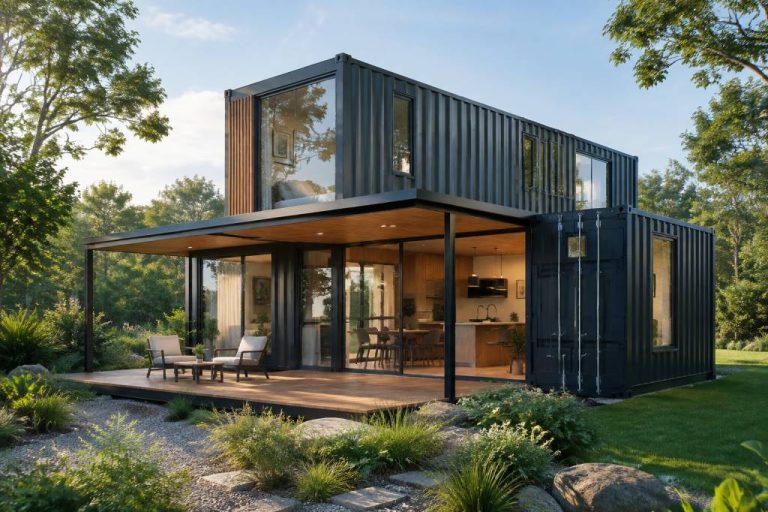

Adaptive reuse of containers for schools, clinics and emergency shelters
Transforming shipping containers into schools, clinics or emergency shelters is no longer a curiosity. It is becoming a real segment of modular construction, avec ses règles du jeu, ses performances mesurables et ses limites bien concrètes. In this article, we will look at when containers make sense for social infrastructure, what technical points cannot be ignored, and how recent projects are dealing with comfort, regulation and long‑term durability.
Why containers are attractive for schools, clinics and shelters
A standard 40 ft high cube container offers about 28–30 m² of floor area. It is stackable, has a certified steel structure and is dimensioned to withstand rough transport conditions. For emergency projects or rapidly growing communities, this brings three main advantages.
Speed of deployment
- Existing global stock: millions of surplus containers are available in or near major ports.
- Fabrication in parallel: interior fit‑out can be done in a factory while site works (foundations, networks) progress on site.
- Assembly in days: a small school block of 4–6 modules can be craned into place and connected in less than a week once the modules are ready.
Predictable cost
- Base structure cost is known: used container prices often fluctuate between 2,000 and 4,000 USD per unit depending on region and condition.
- Fit‑out is standardizable: once a wall build‑up (insulation, cladding), a window type and an HVAC strategy are defined, costs per m² stabilise quickly.
- Transport cost is optimised: containers are dimensioned for trucks, rail and ships, which reduces surprises on logistics.
Reusability and redeployment
- Modules can move: a temporary school near a construction site can later be relocated as a community center or clinic.
- Structure is durable: the corten steel envelope, if properly treated, offers a design life similar to conventional steel buildings.
- Resale value: unlike a fully site‑built temporary structure, a set of container modules can retain a residual market value.
These benefits explain why containers are frequently proposed after natural disasters, in refugee camps, on isolated industrial sites or in fast‑growing peri‑urban areas. But speed and apparent low cost can hide technical traps, especially for uses as demanding as classrooms or healthcare.
Performance requirements: more demanding than housing
Designing a family home in containers is already a technical exercise (thermal bridges, condensation, acoustic comfort). Designing a school, clinic or shelter raises the bar further.
Occupancy density
- A classroom can host 25–35 children in less than 40 m².
- A waiting room in a clinic or emergency shelter may see peaks of 1 person/m².
This means higher internal heat gains, more CO₂ production, and stricter requirements for ventilation and acoustic control.
Indoor air quality
- Schools: many national guidelines target 1000 ppm CO₂ as an upper limit for classrooms.
- Clinics: air changes per hour (ACH) are critical in consultation rooms and treatment areas, sometimes requiring 6–12 ACH with filtration.
- Emergency shelters: mixed uses (sleeping, cooking, storage) can quickly degrade air quality in compact spaces.
Accessibility and safety
- Fire resistance of wall assemblies and escape routes.
- Accessibility standards (ramps, door width, clear turning spaces) for patients and children with reduced mobility.
- Separation of flows: in clinics, circulation paths for staff, patients and waste must be clearly organised, which is challenging in narrow 2.44 m wide containers.
In other words, a “basic” container fit‑out that could work for an office on a construction site will not be enough for a school block or a rural health post that will operate all day, sometimes in extreme climates.
Adaptive reuse in education: from single classroom to full campus
Container schools generally appear in three types of context: post‑disaster reconstruction, overflow of existing schools, and long‑term modular campuses in land‑constrained cities.
Post‑disaster and temporary schools
After earthquakes or floods, tent schools are often deployed first. Containers usually arrive in a second phase, when authorities want something more durable but still fast.
- Configuration: single or double‑stacked units, aligned along a covered external corridor.
- Benefits: better acoustic separation than tents, secure storage for teaching materials, resistance to wind and rain.
- Points of attention: overheating in hot climates is the most common feedback problem, especially when operators underestimate roof insulation and shading needs.
Overflow classrooms in growing cities
In dense urban environments, new permanent buildings can take years to plan and authorise. Modular container classrooms can be delivered in months and installed in school yards, on parking decks or on top of existing structures.
- Vertical expansion: stacking 2–3 levels of classroom modules on a reinforced platform is a common strategy.
- Noise control: classrooms must maintain acceptable reverberation times (often 0.6–0.8 s). Interior acoustic panels and suspended ceilings become mandatory.
- Integration: interface with existing sanitary blocks, canteens and playgrounds often dictates module layout more than the containers themselves.
What works technically for schools
- External insulation strategy: insulating outside the steel shell (SIP panels, ventilated façades) minimises thermal bridges at the container ribs.
- High‑performance roofing: white or reflective roofs plus 100–150 mm of insulation can reduce roof surface temperatures by 15–25°C in hot climates.
- Cross‑ventilation: window placement on opposing walls and operable high‑level openings are key when mechanical ventilation is limited.
- Sunshades and verandas: a simple continuous canopy along the façade improves both summer comfort and rain protection during class changes.
Containers for clinics: when steel boxes become medical spaces
Healthcare use is less forgiving than education. A container clinic must respond to strict hygiene, comfort and technical constraints.
Typical programme of a basic container clinic
- Reception and waiting area.
- 1–2 consultation rooms.
- A small treatment room or vaccination room.
- Storage for medicines and medical waste.
- Sanitary facilities.
Fitting this into two or three 40 ft units is feasible, but circulation and zoning must be carefully studied to avoid cross‑contamination and to maintain privacy.
Key technical challenges
- Thermal stability: some vaccines and medicines require stable temperatures; frequent power cuts in remote areas make passive performance (insulation, shading) more critical.
- Hygiene surfaces: floor and wall finishes must be washable and resistant to disinfectants; this often means replacing standard gypsum boards with fibre‑cement, PVC or HPL panels.
- Services integration: medical gases, abundant electrical outlets, backup power and data connections are more complex to route in narrow walls with heavy steel members.
Field feedback
Projects deployed in Sub‑Saharan Africa and South Asia often report the same lessons:
- Split‑type air conditioners or compact HVAC units are almost always needed, even with good insulation.
- Covered external waiting areas reduce indoor density peaks and lower cooling loads.
- Modular “add‑ons” like awnings and external toilets allow the core medical functions to stay inside controlled, insulated space.
When designed properly, container clinics offer strong advantages: they can be fully fitted in a factory with equipment tested before shipping, they are robust against vandalism, and they can be relocated if population patterns shift.
Emergency shelters: balancing speed, dignity and flexibility
For emergency shelters, two very different logics often coexist:
- Short‑term crisis response (weeks to months) where tents or lightweight prefab systems dominate.
- Protracted displacement (months to years) where containers may be justified despite higher upfront cost.
Individual vs collective shelters
- Individual units: one 20 ft or 40 ft container per household, sometimes with minimal partitioning.
- Collective dormitories: larger open‑plan spaces, with bunk beds and shared sanitary facilities outside.
Containers are often perceived as more secure and more “house‑like” than tents. However, thermal discomfort and lack of privacy are recurrent issues if the interior layout and envelope are not carefully handled.
Design principles for humane container shelters
- Avoid metal‑box syndrome: always add a second skin (external cladding, roof overhangs, shading) to cut direct solar gains.
- Use modular partitions: lightweight, demountable partitions allow reconfiguration as family sizes or functions change.
- Separate night and day spaces: even in 28 m², a simple visual separation between sleeping and living areas improves perceived comfort.
- Plan for services outside the box: cooking, washing and social activities can take place in semi‑open structures between containers, reducing indoor humidity and fire risk.
Materials and insulation: what actually works in container retrofits
Reusing containers for social infrastructure forces designers to confront a basic fact: the steel shell is a thermal and acoustic bridge. Everything depends on how we “wrap” it.
Insulation strategies
- Interior insulation with steel kept visible outside
Pros:
- Protects insulation from weather and vandalism.
- Allows container aesthetics to remain visible (important for some donors or branding).
Cons:
- Reduces interior width (already limited to 2.44 m).
- Thermal bridges at corner posts and floor beams are harder to treat.
- Risk of interstitial condensation if vapour barrier is poorly detailed.
- Exterior insulation with ventilated façade
Pros:
- Continuous insulation around the steel, better thermal performance.
- Interior dimensions mostly preserved.
- Easier to reach higher energy standards for long‑term buildings.
Cons:
- More exposed to mechanical damage.
- Requires additional framing and cladding, increasing cost and thickness.
For schools and clinics with high internal gains and frequent occupation, exterior insulation plus a ventilated façade (metal, fibre‑cement, timber) is often the most robust option.
Typical insulation levels
Values vary by climate, but many successful projects aim for:
- Roof: 100–150 mm of mineral wool or PIR (U‑values around 0.20–0.30 W/m²K in temperate climates).
- Walls: 80–120 mm with a continuous layer avoiding steel ribs.
- Floor: 60–100 mm, especially when the container is raised off the ground on piers or blocks.
Interior finishes
- Schools: durable vinyl or linoleum floors, impact‑resistant wall panels up to 1.2 m height, acoustic ceiling tiles.
- Clinics: homogeneous welded vinyl flooring with upturn at walls, washable wall panels, flush skirtings.
- Shelters: simpler finishes can be acceptable, but easy cleaning is still a priority.
Cost, timelines and when containers really make sense
A common misconception is that container buildings are automatically cheaper. Field data suggest a more nuanced picture.
Cost structure
- Container shell: often 10–20% of total project cost.
- Fit‑out (insulation, partitions, finishes): 40–50%.
- MEP (mechanical, electrical, plumbing): 20–30%.
- Transport, cranage, foundations: 10–20% depending on distance and site complexity.
Compared to light steel or timber modular systems, container‑based solutions can be cost‑competitive when:
- There is local availability of used containers at reasonable price.
- The site is remote or constrained, making robust prefabricated modules attractive.
- Redeployment or resale of modules is planned.
Where containers are scarce or expensive, or when very high performance is required (for example, a large hospital), purpose‑designed modular systems often outperform container reuse in both cost and comfort.
Typical timelines
- Design and permitting: 1–3 months for small projects, longer for complex clinics.
- Factory fit‑out: 4–8 weeks for a batch of classroom or clinic modules.
- Site preparation: 2–4 weeks (foundations, utilities, access).
- On‑site installation and commissioning: from a few days to 2 weeks.
Compared to conventional construction, total delivery time can be cut by 30–50%, especially when factory and site works are run in parallel.
Regulatory and health issues: do not skip the boring part
Because containers look like “temporary” structures, some projects are tempted to bypass regulations. For schools and clinics, this is a serious mistake.
Fire safety
- Check fire resistance of wall and roof assemblies (EI30, EI60, etc. depending on local codes).
- Use non‑combustible or low‑combustible insulation and finishes where required.
- Ensure at least two independent escape routes for classrooms and waiting areas above specific occupancy thresholds.
Structural checks
- Containers are strong, but only in their original configuration. Cutting large openings in side walls or removing portions of the roof requires additional framing.
- Stacking more than two or three levels may go beyond standard container certification and require full structural calculation.
Health and hazardous materials
- Some used containers may have transported chemicals; a thorough inspection and, if necessary, surface treatment is essential.
- Original marine paints can contain heavy metals; covering them with appropriate coatings or claddings reduces risk.
Working with local authorities from the start typically avoids retrofits that are more costly than doing things correctly the first time.
Operational feedback: what users tell us from the field
Beyond technical specifications, the success of container schools, clinics and shelters ultimately depends on how people experience them.
- Thermal comfort is non‑negotiable: in hot climates, under‑insulated containers become unusable by midday; in cold regions, poor detailing at junctions causes condensation and mould.
- Acoustics matter in schools: projects that ignored acoustic treatment often report high noise levels, teacher fatigue and concentration issues for students.
- Natural light is a key satisfaction driver: users consistently prefer modules with generous windows, even if this complicates structural modifications.
- External spaces are part of the architecture: covered walkways, shaded patios and simple benches between modules significantly improve everyday use.
Interestingly, many teachers and healthcare staff initially sceptical of “metal boxes” change their view when they see a well‑insulated, well‑lit and properly ventilated container facility. Conversely, poor first experiences can damage the reputation of the entire approach.
Key questions to ask before starting a container project
To close, a kind of implicit checklist, consistent with how many successful operators now approach container reuse for social infrastructure:
- Is the site context really compatible with containers? (climate, logistics, expected lifespan, potential need for relocation)
- What occupancy and performance levels are required? (school, clinic, shelter: each has different air quality, acoustic and security needs)
- Which insulation and ventilation strategy is planned? (and does it account for local energy costs and maintenance capabilities?)
- Are regulations fully mapped? (fire, accessibility, structural, health) and who is responsible for compliance?
- How will the modules age? (corrosion protection, roof maintenance, flexibility to adapt interior layouts)
- What happens at end of first use? (redeployment, resale, transformation to another function)
Adaptive reuse of containers for schools, clinics and emergency shelters is not a shortcut around good design and engineering. It is another tool, powerful when correctly specified, risky when adopted as a quick fix. For architects, operators and communities willing to engage seriously with the technical, regulatory and human factors, container‑based infrastructure can deliver fast, robust and surprisingly comfortable places to learn, heal and find refuge.
À propos de l'auteur