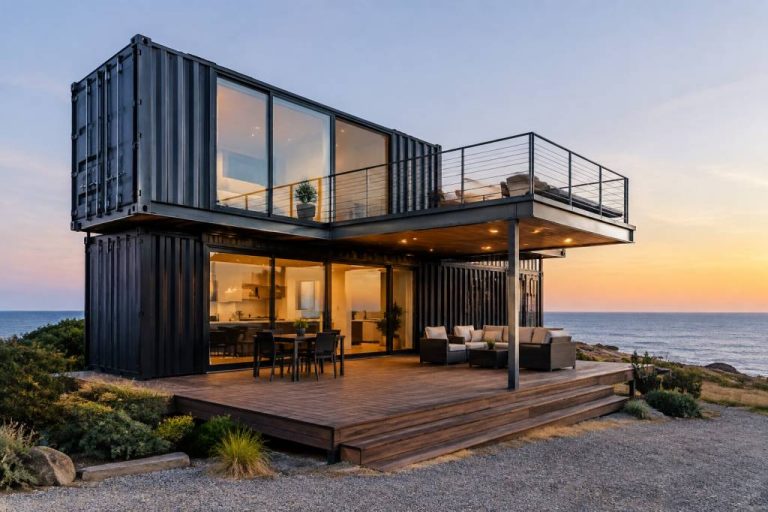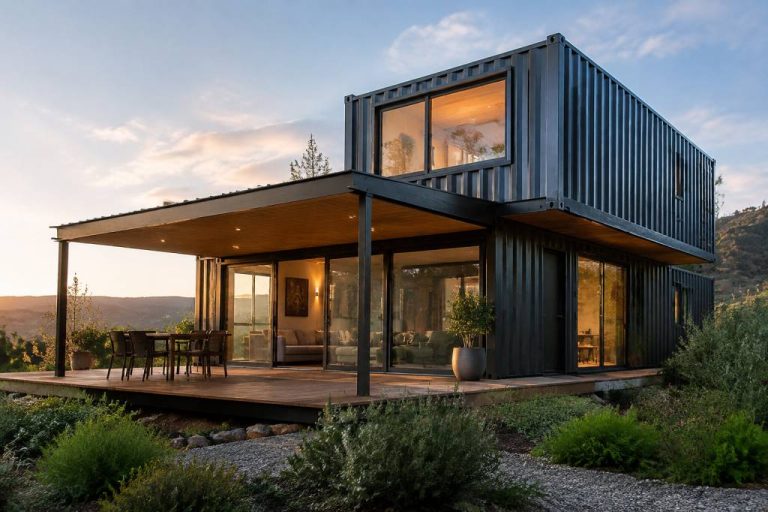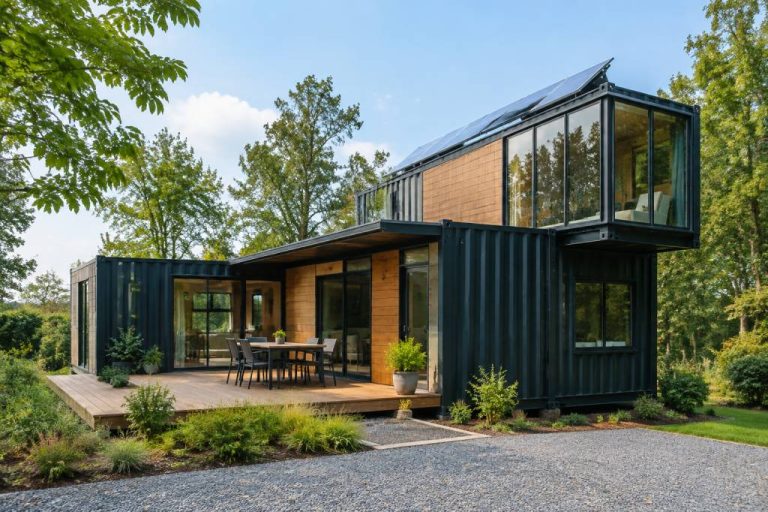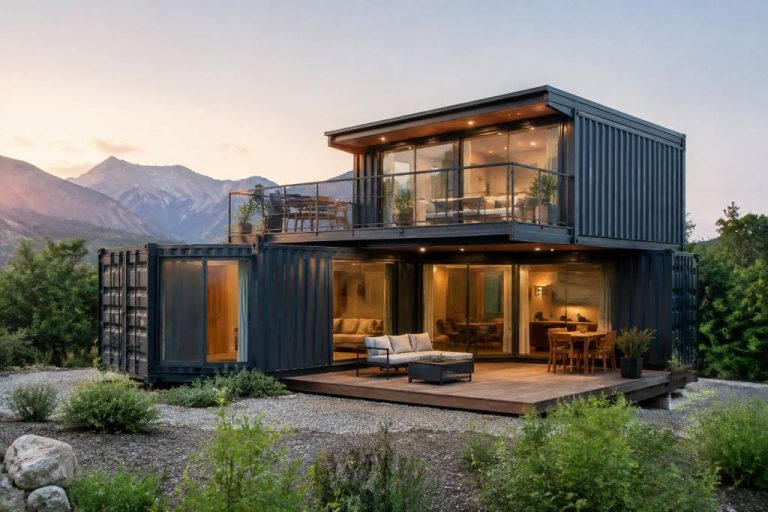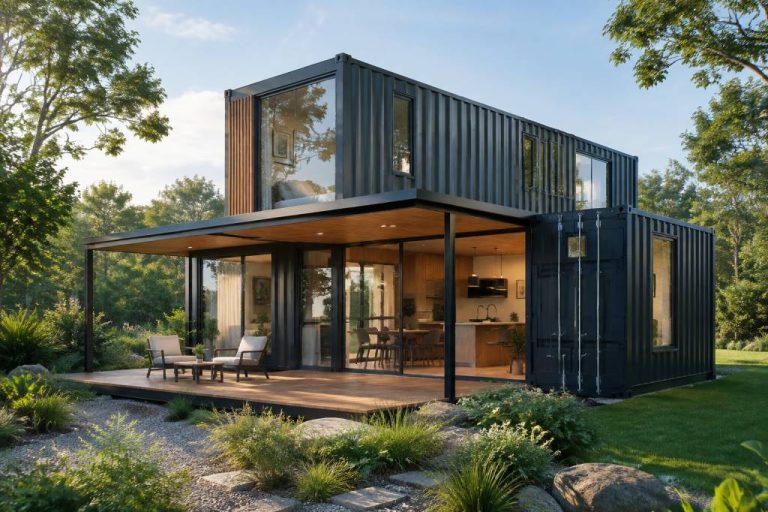
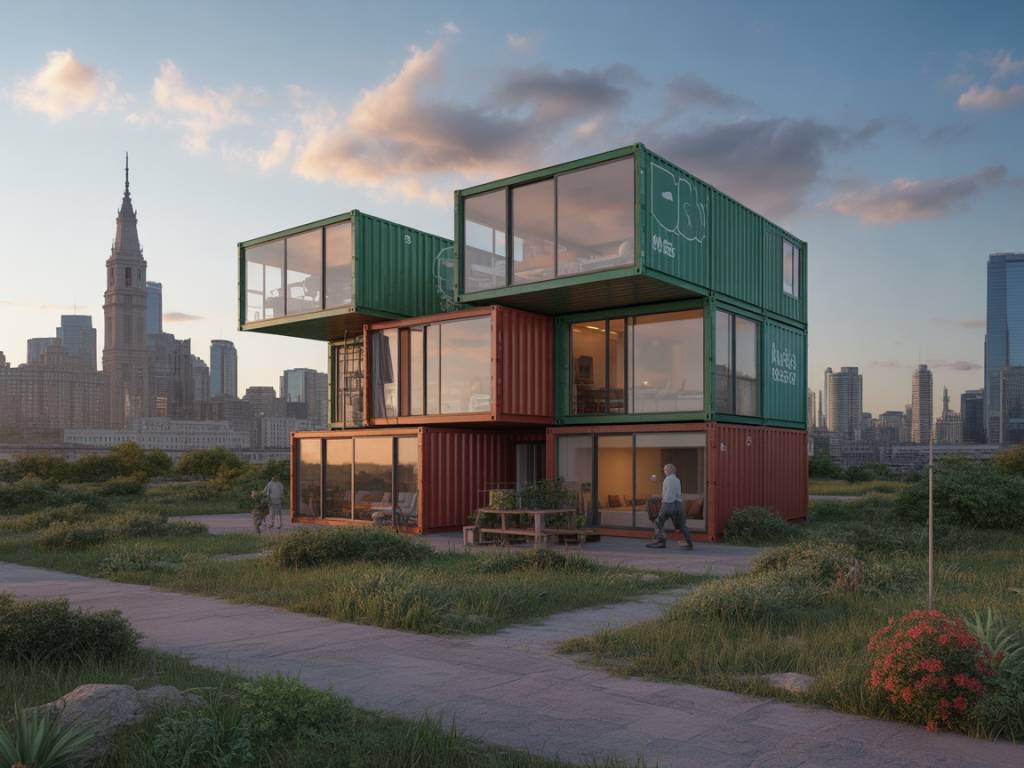
How container homes are reshaping sustainable architecture in urban areas
In most dense cities, the gap between what we can build and what we would need to build sustainably keeps widening. Construction costs rise, land becomes rarer, and climate targets get stricter. Into this tension-filled space, container homes have quietly crept from experimental projects into serious tools for urban planning. Not as a miracle solution, but as a pragmatic one: fast, recyclable, modular, and relatively affordable—provided they’re done properly.
Why containers make sense in the city
A standard shipping container is a highly optimized industrial product. Designed to carry 20 to 30 tonnes of goods and be stacked up to 8 or 9 units high on ships, it offers a structural capacity that conventional light construction simply doesn’t match at the same price point.
From an urban sustainability perspective, three factors stand out:
- Re-use of an existing structure: A used 40-foot container represents roughly 3.5 to 4 tonnes of steel that do not need to be produced again. Steelmaking accounts for around 7–9% of global CO₂ emissions; extending the life of this steel instead of scrapping and remelting it is a tangible gain, especially if you use “one-trip” containers that are structurally sound but no longer needed for shipping.
- Compactness and stacking ability: In dense areas where every square meter of ground counts, building vertically with a fully engineered, stackable frame is a major asset. Containers can be stacked on small plots, above existing buildings (with appropriate structural checks), or around courtyards while minimizing foundations.
- Speed of implementation: Factory-fit container modules can be delivered almost ready to live in. On-site assembly often takes days to weeks instead of months. In urban contexts where noise and disruption are sensitive issues, reducing site time has real social and environmental value.
Put simply: cities need to build more, faster, with a lower carbon footprint and less disturbance to neighbors. Container architecture fits that equation better than many experimental “green” concepts that remain too complex or expensive to scale.
Urban case studies: from temporary fixes to durable fabric
Container architecture’s shift from fringe to mainstream in cities can be tracked through a few key projects worldwide.
Student and micro-housing in European cities
Student housing is a perfect testbed: high demand, limited budgets, and often temporary land availability. Early projects like “Keetwonen” in Amsterdam (over 1,000 container-based units) demonstrated that modular steel units could provide decent comfort, proper insulation, and acceptable acoustics at scale. While the complex was dismantled, its technical and regulatory lessons spread across Europe.
Today, several cities use containers for student or micro-units:
- Short- to medium-term use on plots waiting for redevelopment, turning “land in limbo” into productive social infrastructure.
- “Plug-in” dormitory extensions where existing campuses cannot expand horizontally.
- Highly standardized room layouts that reduce design time and simplify maintenance.
In most of these schemes, containers are not left raw. They are insulated on the outside, fitted with ventilated façades, and equipped with high-performance windows. The result is closer to a compact apartment in a small-frame building than to a “box” on a dock.
Container clusters as urban fillers
In London, the “Container City” developments at Trinity Buoy Wharf showed early on how containers could colonize forgotten riverfront or industrial pockets. Retail, workshops, offices, and housing were combined in an ad-hoc but structurally robust system. The key lesson: cities are full of residual spaces where conventional construction is economically unviable, but modular steel boxes can be installed, tested, and eventually relocated.
On a smaller scale, many cities now deploy container-based systems for:
- Pop-up cultural spaces and galleries
- Interim offices on redevelopment sites
- Small co-living clusters and co-working hubs
These projects function as laboratories for urban planners: they measure how people actually use semi-temporary space, how noise and circulation work, and whether a permanent building is justified.
Emergency and transitional urban housing
For populations displaced by redevelopment, natural disasters, or major renovation programs, container-based modules provide an option that is both faster and more durable than tents or light shelters. In several cities, container villages have been set up as transitional housing, with proper sanitation and communal facilities, on municipal land.
This is where the “urban sustainability” dimension becomes social as much as environmental. Reusable modules can be reconfigured, moved from one site to another, and adapted over time, rather than being demolished after a single use.
From steel box to sustainable home: performance matters
If container homes are to be part of urban sustainable architecture, they must meet the same performance expectations as any good city dwelling: energy efficiency, acoustic comfort, fire safety, and indoor air quality. The bare container itself is only the structural shell; what you add around and inside makes the difference.
Thermal performance and insulation
The steel walls of a container conduct heat very efficiently. Left uninsulated, you get a baking oven in summer and a fridge in winter. To reach typical European standards for low-energy buildings, walls usually target a U-value in the 0.15–0.25 W/m²·K range. In practice, that means:
- External insulation whenever possible, to avoid thermal bridges and keep the steel within the insulated envelope. Common options include mineral wool, expanded polystyrene (EPS), extruded polystyrene (XPS), or wood-fiber panels, protected by a ventilated façade (metal, fiber-cement, timber cladding, etc.).
- Internal insulation in constrained urban projects where façades must align or where the external aesthetic of containers is maintained. Here, rigid polyisocyanurate (PIR) or phenolic foam boards are often used to minimize thickness while maximizing R-value.
- Systematic treatment of thermal bridges at floor edges, corner posts, and cut-out openings for windows and doors. Without it, condensation and mold will appear quickly in urban climates with significant humidity and temperature swings.
In well-designed projects, the performance gap between a container module and a conventional light-gauge steel or timber-frame module essentially vanishes. The key is not the container; it is the envelope you create around it.
Acoustics: a decisive factor in dense neighborhoods
In cities, noise is not a minor issue. Container walls are thin steel plates that efficiently transmit impact and airborne noise unless treated. Sustainable urban architecture has to consider comfort as much as kilowatt-hours.
Serious container projects now integrate:
- Double walls with decoupled studs (steel or timber) and mineral wool in between to break vibration paths.
- Floating floors with resilient layers to absorb impact noise from footsteps.
- Double or triple glazing with proper seals around frame cut-outs.
With these measures, inter-unit acoustic insulation can meet or exceed typical multi-family building codes. Again, the container acts primarily as a structural skeleton, not as the final wall.
Fire, corrosion, and air quality
Urban building codes are rightly strict about fire behavior and health. Some points to watch:
- Original container paints and floor treatments (often plywood with insecticide and fungicide treatments) are not intended for habitation. They must either be removed, encapsulated, or replaced. Failing to do so jeopardizes indoor air quality.
- Insulation and interior finishes need to be fire-rated (reaction-to-fire class, smoke production, etc.) and installed with attention to joints and penetrations to maintain compartmentation.
- Corrosion protection, especially in polluted or coastal urban environments, is critical. Cut edges and welds must be properly treated, and any external insulation system must manage moisture to avoid trapping water against the steel.
When these aspects are anticipated and handled at the design stage, container homes can integrate seamlessly into the regulatory frameworks of sustainable urban buildings.
Economics: when do containers really save money?
Container architecture is often sold on the promise of “cheap housing.” Reality is more nuanced. In urban areas, savings rarely come from the raw shell itself, which may cost a few thousand dollars or euros per unit, but from time and process.
Where containers can be economically advantageous:
- Speed reduces financing costs: Shorter construction times mean less interest on loans and a quicker start to rental or operational revenue.
- Repetition and modularity: Identical units and standardized details reduce design time and on-site errors. MEP (mechanical, electrical, plumbing) can be highly rationalized.
- Use of challenging plots: Brownfields, narrow or oddly shaped lots, rooftops, and temporary land leases where conventional construction would be financially risky.
On the other hand, once you include:
- High-performance insulation and façades
- Regulation-compliant stairwells and corridors
- Elevators, accessibility, fire-safety systems
- Urban permits, design fees, and engineering
…the total cost per square meter of a well-finished container building in a city can be similar to that of other modular or lightweight systems. The real economic value lies in flexibility and speed, not in magical cost-cutting on materials.
Urban planning and regulation: from exception to recognized typology
For container homes to genuinely reshape sustainable architecture, planners and regulators need to know how to categorize them. Temporary? Permanent? Mobile? Each status implies different rules for fire safety, accessibility, foundations, and energy performance.
In many cities, we see three main patterns emerging:
- Temporary urbanism: Containers are authorized for limited durations (5–15 years) on plots awaiting redevelopment. Technical requirements may be slightly relaxed, but minimum comfort and safety are enforced. This is a way to “test” container neighborhoods without committing land permanently.
- Hybrid mixed-use blocks: Lower floors in conventional concrete or steel structures, upper floors in container or modular units. This responds to urban constraints (parking, commercial ground floors, public facilities) while still gaining speed and prefabrication benefits for housing.
- Permanent modular neighborhoods: Actual container districts integrated into zoning plans, with full compliance to long-term building codes. Here, containers are treated as a form of modular steel construction, not as a separate object.
As more case studies prove performance and durability, we see a shift: containers move from being “tolerated exceptions” to “one more tool in the urban toolbox.” This change is crucial for investors and public authorities who need regulatory predictability to scale up projects.
Limits and misconceptions
Container architecture has its own mythology, amplified by social media: ultra-cheap DIY homes, minimal intervention, off-grid autonomy just outside the city. In dense urban areas, this picture is largely unrealistic.
Some recurrent misconceptions:
- “Containers are always more ecological than concrete or timber.”
Not necessarily. The environmental balance depends on the quality of insulation, lifespan, and how often the modules are reused. Reusing one container poorly insulated for 10 years may be worse, in energy terms, than building a high-performance timber module designed for 50 years. - “You can just drop a container on a plot and live in it.”
Urban plots come with strict rules: stormwater management, fire access, height limits, noise regulations, heritage constraints, and more. Ignoring these leads to legal dead ends. - “Containers are structurally indestructible.”
They’re very strong in their original box shape, but every opening cut in walls or corner posts modifies their behavior. For multi-story urban buildings, structural engineering is non-negotiable, especially in seismic zones.
Understanding these limits does not weaken the case for container homes; it clarifies when and how they are truly relevant in the city.
What urban stakeholders should check before opting for containers
For municipalities, developers, or self-builders operating in urban contexts, a few key questions help determine whether containers are the right choice:
- Is the land permanent or temporary?
If the land is available only for 5–20 years, a relocatable container village can be more rational than a heavy, site-specific structure. - What is the desired level of energy performance?
If you aim for near-zero energy or passive-house standards, ensure that the container system is compatible with thick insulation, high-performance windows, and airtight detailing. - How complex is the program?
Simple, repetitive units (student housing, micro-apartments, offices) are ideal for containers. Highly customized layouts or large spans (open-plan schools, sports halls) may be less suited. - What about urban integration?
Will the project face strong aesthetic or heritage constraints? If so, plan for cladding, green façades, or mixed-material envelopes to soften the container image. - Is there local expertise?
Architects, engineers, and contractors experienced with modular steel systems can make or break the project’s quality and sustainability.
Answering these questions upfront often reveals whether the container is a relevant structural module or if another prefab system would be more efficient.
How container homes are nudging urban design forward
Beyond their practical qualities, container homes are changing how we think about buildings in cities.
Buildings as movable assets
A container module can move from a vacant lot to a rooftop, from a temporary student village to a permanent co-housing project. This portability encourages us to see buildings less as immovable, single-use objects and more as mobile assets that can adapt to the life cycle of the city.
Modularity as a planning tool
Urban planners can now think in terms of “bands” or “clusters” of units that can grow, shrink, or change function over time. A block of 50 units might start as temporary housing for workers next to a large site, then be relocated and converted into social housing or emergency shelters.
Material circularity
Containers are not only reused once; they can be reincorporated into other projects, dismantled, or their steel recycled. Combined with reversible connections and dry assembly techniques, they fit well into a circular-economy logic that cities increasingly aim for.
In that sense, the impact of container homes on sustainable urban architecture goes beyond their metal walls. They force cities to confront a new question: what if a building didn’t have to be “forever” on a specific plot to be worth building?
Used intelligently, with proper insulation, regulation-aware design, and realistic economic expectations, container homes are less a trend and more a compact, flexible answer to some of the toughest constraints of dense, sustainable cities.
À propos de l'auteur