


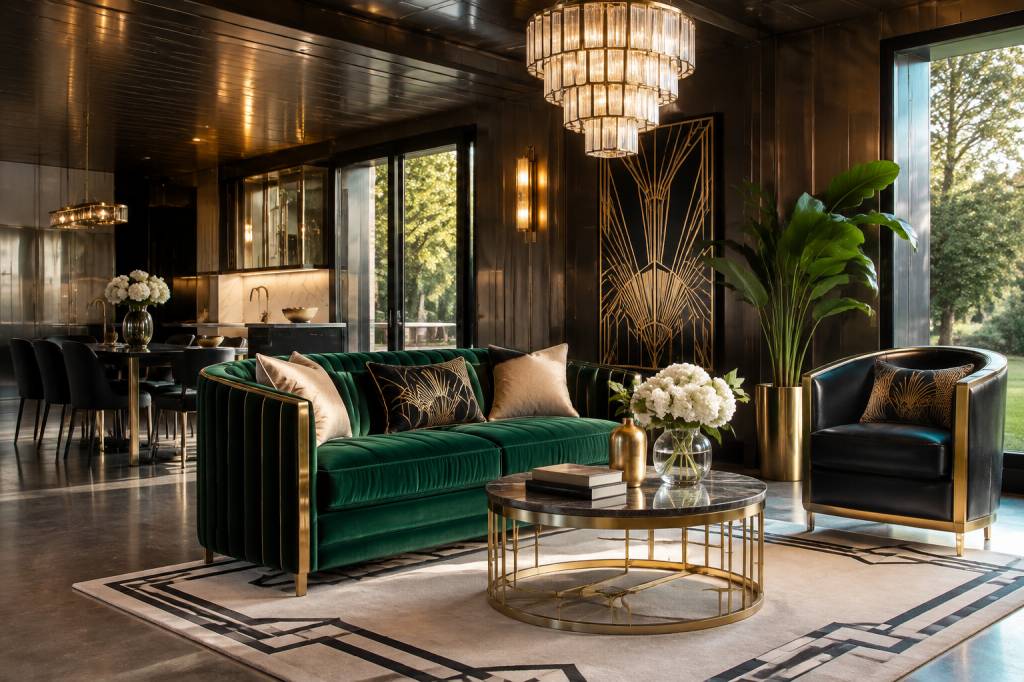
Art Deco can make a container home feel deliberate rather than merely compact. Its defining ingredients—strong geometry, repeated lines, reflective surfaces and carefully chosen color—work especially well in a small interior, where every finish and fitting is visible. But a shipping container is not a conventional room with unusual walls. Its narrow proportions, steel shell, insulation build-up and limited openings all affect how an Art Deco scheme should be planned.
The most successful approach is not to recreate a 1920s hotel suite in miniature. It is to borrow the style’s visual language and adapt it to the structure. That means choosing a few clear motifs, using durable materials, and checking that decorative choices do not compromise insulation, ventilation or access to services.
Start with the container’s proportions
A standard 40-foot shipping container is about 12.2 metres long and 2.4 metres wide externally. Its usable internal width is less, and the finished room becomes narrower once wall insulation and interior lining are installed. A high-cube model adds roughly 30 centimetres of external height compared with a standard-height container, which can make a noticeable difference to ceiling treatments and lighting.
These dimensions matter because Art Deco often relies on symmetry, strong verticals and repeated patterns. A large, elaborate feature wall may overwhelm a narrow room; a modest geometric panel can give it structure without making it feel smaller. Before choosing furniture or wallpaper, mark the finished wall positions, door swings, windows and service runs on a floor plan.
It also helps to decide where the eye should land when someone enters. In a long container, that might be a framed view at the far end, a compact dining nook, or a patterned panel behind a sofa. A clear focal point makes the interior feel composed and helps prevent decorative details from competing with one another.
Use geometry as the main design tool
Art Deco patterns are often built from fan shapes, stepped forms, sunbursts, chevrons and repeated arches. In a container home, these motifs can be introduced through a single element rather than applied everywhere. Consider a fan-patterned backsplash, a stepped timber headboard, or a set of narrow brass-colored lines painted onto a plain cabinet front.
Scale is important. Small, high-contrast patterns can become visually busy across a long wall, especially in a space with a low ceiling. Larger, simpler shapes are often easier to read. A practical test is to make a paper template or use removable tape to mark the pattern at full size before committing to paint, tile or joinery.
Repetition can also help a narrow room feel intentional. For example, matching wall lights placed at regular intervals create a rhythm along a corridor-like living area. The fixtures do not need to be identical in every detail, but their height, spacing and visual weight should relate to each other.
Choose a controlled palette
Classic Art Deco interiors often combine deep colors with pale neutrals and metallic accents. A container home can use the same contrast, but the balance matters. Dark green, navy or burgundy can add depth to one wall or a built-in unit; using these colors on every surface may make a narrow room feel enclosed.
A useful starting point is one dominant neutral, one rich accent color and one metal finish. Warm white or light stone can reflect daylight, while a deep color defines a focal area. Brass, bronze or chrome can appear in handles, lighting and furniture details. Keeping to one main metal finish usually creates a more coherent result than mixing several competing tones.
Color should be tested under the actual lighting conditions. A shade that looks warm in a shop may appear cooler beside a large window or under LED lighting. Paint sample boards and move them around the room at different times of day. This is a low-cost step that can prevent a large, expensive repaint.
Bring in shine without adding visual clutter
Reflective surfaces are strongly associated with Art Deco, and they can help distribute light in a compact interior. A mirror, polished metal trim or glazed tile may be more effective than a large area of glossy finish. Place reflective details where they catch daylight or a lamp, not where they create glare or reflect an untidy work zone.
Mirrors can also make a small room feel broader, but their position matters. A full-height mirror at the end of a narrow space may exaggerate its length. A mirror positioned across from a window can brighten the room, provided it does not create uncomfortable glare or reveal neighboring properties where privacy is needed.
For a more practical, lower-maintenance scheme, use satin or semi-gloss finishes on high-contact surfaces and reserve high gloss for small details. In a kitchen or entry area, fingerprints and water marks can quickly become visible on mirror-like cabinetry. The visual effect should be balanced against cleaning requirements.
Select materials for appearance and performance
Art Deco is often associated with marble, exotic timber and polished metal. A container home does not need to use large quantities of heavy or costly materials to evoke that look. A small stone or stone-effect surface, a fluted cabinet front, or a carefully detailed timber panel can provide the same visual cues with less weight and expense.
Weight is not the only consideration. Any added finish must be compatible with the wall assembly and the container’s moisture strategy. Steel walls can be vulnerable to condensation if warm indoor air reaches cold metal surfaces. Insulation, air sealing and ventilation need to be designed as a system, with suitable detailing around windows, corners and service penetrations. Decorative wall panels should not conceal dampness or prevent inspection where access is needed.
Choose finishes according to their location. In a kitchen, use a wipeable backsplash and moisture-resistant cabinet materials. In a bathroom, select finishes rated for wet areas and detail junctions carefully. For floors, consider a durable surface that suits the structure and does not introduce unnecessary dead load. If the container is modified or stacked, a qualified designer or engineer should assess structural implications before heavy elements or large openings are added.
Make lighting part of the architecture
Lighting is one of the most effective ways to give a container interior an Art Deco character. Rather than relying on one central ceiling fixture, use layers: general lighting for movement and tasks, focused lighting for reading or cooking, and accent lighting to highlight a pattern or material.
Opal glass, ribbed glass and stepped metal forms can suggest the period without requiring custom-made fittings. In a narrow room, wall-mounted fixtures can free up ceiling space and create a deliberate rhythm. Check the fixture’s projection, however: a large sconce in a tight passage can become an obstacle.
Plan lighting before closing the walls. Electrical routes, junction boxes and mounting points are easier to coordinate while the interior lining is still open. This is particularly important in a container, where retrofitting cables can mean removing finished panels or cutting through carefully designed insulation layers. Use fittings appropriate to their location and have electrical work completed in line with local regulations.
Use built-in furniture to keep the room clear
Art Deco furniture is known for bold silhouettes, but a container home benefits from pieces that respect circulation. Built-in benches, shallow shelving and storage that follows the wall can preserve usable floor area. A banquette with a curved end, for instance, can introduce a period-inspired shape while making a dining corner more efficient.
Before buying a sofa, cabinet or dining table, measure the finished space—not the bare steel shell. Include clearance for doors, drawers, appliances and people passing through. A piece that fits on a floor plan may still obstruct a route when its doors are open.
Look for furniture with clean outlines and one or two distinctive details: a stepped base, rounded corners, ribbed fronts or contrasting inlay. These features deliver character without filling the room with ornament. Vintage pieces can be a good source of authentic detail, but check their dimensions, condition and weight before bringing them into a compact building.
Keep decoration focused and maintainable
In a small interior, decoration works best when it is edited. A single framed print, a geometric rug and a sculptural lamp may be enough to establish the style. Too many patterns can compete with the container’s visible structural lines, especially if corrugations remain exposed on an exterior wall or ceiling.
Textiles are an easy way to adjust the scheme without permanent work. Curtains, cushions and rugs can introduce fan patterns or strong colors, and they can be replaced if the room’s use changes. Choose window treatments that suit the opening and do not block ventilation or interfere with doors. In a compact home, fabrics should also be selected with cleaning and moisture conditions in mind.
For a more sustainable project, consider reclaimed timber, refurbished lighting and secondhand furniture. Reuse can reduce demand for new materials, but it still requires inspection. Check reclaimed wood for pests and damage, confirm that old electrical fittings are safe to restore, and avoid finishes that may release unwanted substances indoors. A distinctive look is valuable; a hidden maintenance problem is not.
Test the scheme before committing
Many Art Deco details can be prototyped inexpensively. Try a paint sample on a board, mock up a feature panel with masking tape, or arrange furniture using cardboard outlines. These tests reveal whether a motif is too large, whether a dark color absorbs too much light, or whether a proposed light fixture projects into a walkway.
A simple design checklist can keep the project on track:
- Confirm the finished internal dimensions after insulation and lining.
- Choose one focal point and limit competing patterns.
- Test colors and reflective finishes in natural and artificial light.
- Coordinate decorative panels with ventilation, wiring and service access.
- Check furniture clearances, door swings and circulation routes.
- Review material weight, moisture resistance and cleaning needs.
The strongest Art Deco container homes do not depend on expensive replicas or elaborate ornament. They use proportion, geometry, contrast and light with restraint. A repeated brass detail, one confident color and a well-placed geometric feature can give a compact structure a distinctive identity—while leaving the insulation, circulation and everyday function intact.