


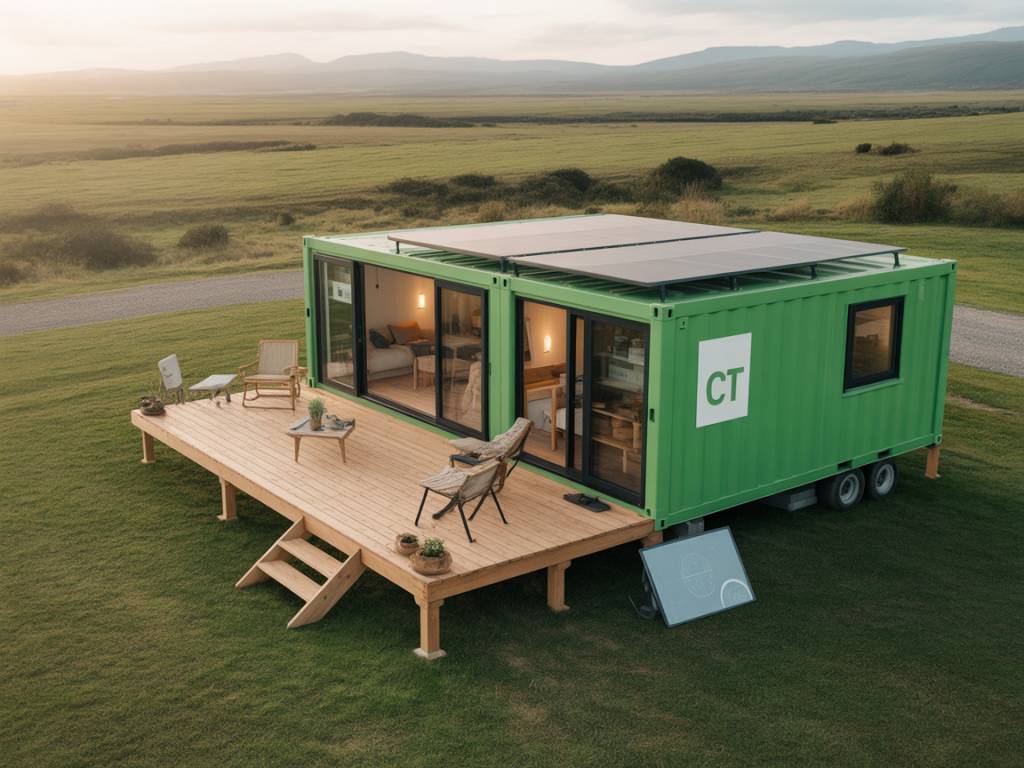
Designing an off-grid container house is a bit like designing a small industrial facility: tight volume, limited surfaces, clear constraints… and the need for a system that works 24/7 without drama. When you add renewable energy and storage to the equation, the house becomes a piece of infrastructure as much as a piece of architecture.
The good news: containers are robust, modular and predictable. That makes them particularly well suited to off-grid systems, as long as you start with the energy strategy from day one, not the week before pouring the slab.
Why off-grid pairs well with container architecture
On paper, a shipping container is not the ideal passive shell: it is a steel box, with thermal bridges everywhere. Yet for off-grid design, it offers several advantages:
- Modularity: easy to add a second or third container later and scale the energy system with it.
- Structural capacity: roof and sidewalls can carry solar arrays, awnings, battery shelters and exterior shading with relatively simple detailing.
- Predictable geometry: standardized dimensions simplify panel layout, cable runs and equipment placement.
- Factory pre-fit potential: in many countries, containers are pre-equipped in workshops with insulation, ducting and wiring for renewables before being shipped to site.
In France, a 40 ft container converted into a 35–40 m² micro-home will typically see an annual heating demand between 25 and 60 kWh/m² (with proper insulation), which is manageable with a modest solar + battery setup. In southern Spain or Australia, cooling becomes the main load and shading/orientation decisions can easily double or halve your solar requirement.
In short: the metal box is not the problem. The way you insulate it, orient it and size the systems around it will make or break your off-grid project.
Estimating your real energy needs
Most off-grid container projects fail on paper before they fail on site, simply because the initial energy budget is wrong by a factor of two. The first task is brutally simple: list everything that will consume electricity or heat.
For a 1–2 container home (30–60 m²), a realistic daily electrical demand in temperate climates falls between 4 and 10 kWh/day if the design is careful. To land in the lower half of that range, you need to make a few strategic decisions early:
- Cooking: gas or efficient induction? All-electric kitchens off-grid are possible but more expensive on the storage side.
- Hot water: solar thermal, heat pump, or resistive electric? The choice has a huge impact on peak loads.
- Heating / cooling: small split heat pump vs direct electric heaters vs biomass stove.
- Fridge / freezer: A+++ domestic units or DC off-grid appliances.
- Water pumping: gravity-fed tanks or pressure pumps running regularly?
A very basic consumption breakdown for a well-designed 40 m² container home in a mild climate might look like this:
- Lighting (LED throughout): 0.3–0.5 kWh/day
- Fridge + small freezer: 0.6–0.9 kWh/day
- Electronics (laptop, router, phone): 0.3–0.6 kWh/day
- Pump for water / greywater: 0.2–0.5 kWh/day
- Cooking (induction or small oven): 0.6–1.5 kWh/day depending on habits
- Miscellaneous (tools, washing machine, etc.): 0.5–1.5 kWh/day
This gives 2.5–5.5 kWh/day before heating and hot water. Add a small heat pump and domestic hot water strategy, and you are typically in the 4–8 kWh/day zone. From there, you can derive solar and battery sizes instead of guessing.
Designing the envelope first: insulation, orientation, loads
A container home that leaks energy will cost you twice: first on the insulation retrofit, then on the renewable system required to compensate. The cost per kWh “not consumed” is almost always lower than the cost per kWh “produced and stored”.
Three envelope decisions have a direct impact on your off-grid system size:
- Insulation strategy: external vs internal, and how you treat thermal bridges.
- Orientation and glazing ratio: free solar gains vs overheating risk.
- Shading and overhangs: to reduce cooling loads in warm climates.
For off-grid, external insulation is often preferable on containers because it wraps the steel and radically reduces thermal bridges. A typical build-up in Europe might be:
- Outside: 80–120 mm rigid PIR or rockwool panels (λ ≈ 0.022–0.036 W/m·K)
- Ventilated cladding (metal, wood, fiber cement)
- Inside: light service cavity (40 mm) for wiring and outlets, plasterboard interior finish
This achieves wall U-values in the 0.18–0.25 W/m²·K range, comparable to new-build standards, and dramatically lowers the heating requirement. In cold or hot deserts, bumping to 140–160 mm insulation thickness is not unusual, and still cheaper than doubling your PV and battery capacity.
On orientation: containers are long rectangles. Placing the long façade south (in the northern hemisphere) or north (in the southern hemisphere) allows more controlled solar gains. Retrofitting a canopy or pergola with integrated PV on that long façade can both shade and produce power. This is often more efficient than overloading the narrow roof with panels at sub-optimal angles.
Solar PV: roof, façades, and ground mounts
In practice, 90% of off-grid container homes today rely on solar PV as the primary source. The main design questions are area, tilt, structure and maintenance access.
A single 40 ft container roof is about 28–30 m². With modern 400–450 W modules (~2 m² each), you can fit 6–10 panels directly on the roof while keeping safe access paths and avoiding shading from parapets, vents or AC units.
That gives roughly 2.4–4.5 kWp. In a decent solar climate (1 200–1 600 kWh/kWp.year), this equates to:
- ~8–12 kWh/day in summer
- ~3–7 kWh/day in winter (depending on latitude and weather patterns)
For a year-round primary residence at higher latitudes (northern Europe, Canada, southern Chile), relying only on roof PV is often not enough if you want winter autonomy without a generator. Three workarounds regularly seen on container projects:
- Ground-mounted arrays: 5–10 m away from the house, easier to orient and tilt optimally, simpler to clean and snow-clear.
- Carport or pergola PV: a double use of steel structure for shade + electricity, ideal for parking or outdoor living space.
- Bifacial façades: vertical modules on the sun-exposed side, producing more in winter when the sun is low.
On a recent off-grid container retreat in Portugal (three 40 ft units), the design team opted for a ground mount of 8 kWp about 20 m from the main cluster. Cost per installed kWp was ~15–20% lower than a complex roof rack structure, and maintenance is now done in minutes, not hours. The shipping containers themselves remained mostly unperforated, which also eased corrosion management.
Wind, micro-hydro and hybrid systems
Solar alone is not always the best answer, particularly in cloudy, windy or mountainous regions. Hybrid systems can reduce the required battery capacity and improve comfort in long winter stretches.
You will see three main complements to PV:
- Small wind turbines (1–5 kW): interesting on exposed sites with average wind speeds above 5–6 m/s. They often produce more in winter, when solar is scarce.
- Micro-hydro: the most reliable renewable if you have year-round flow and a decent head (5–20 m). Continuous low-power production is ideal for charging batteries gently.
- Backup generator: not “renewable”, but strategically sized and rarely used, it can avoid oversizing PV and batteries by 30–40%.
For container homes, micro-wind raises a specific issue: noise and vibration. Avoid fixing a turbine directly to the container structure. Instead, mount it on an independent mast with proper foundation and flexible cable connections to the house. This is non-negotiable if you want to sleep.
In the French Alps, one off-grid container chalet (two 20 ft units) uses 3 kWp of PV, a 1.5 kW turbine on a 9 m mast and a 10 kWh lithium battery bank. The owner reports that in winter storms, PV production drops but wind covers essential loads and keeps batteries above 60% without touching the generator for weeks.
Battery storage: chemistry, sizing, safety
Storage is where off-grid projects get serious, both technically and financially. Batteries can easily represent 30–50% of the electrical system budget. You therefore want a chemistry and configuration matched to your use pattern, climate and maintenance capacity.
Today, three families dominate
- Lead-acid (flooded, AGM, gel): low upfront cost, proven technology, but heavy, bulky and sensitive to deep discharges. Lifetime: 5–10 years if treated carefully.
- Lithium iron phosphate (LiFePO₄): higher upfront cost, but 3–5 times more cycles, better depth of discharge (DoD) and less maintenance. Very common in modern off-grid builds.
- Second-life EV batteries: interesting from a circular-economy angle, but variable quality and integration complexity; more suited to expert or pilot projects.
For a 100% off-grid primary residence, LiFePO₄ is rapidly becoming the default option, especially in container homes where space is tight. Typical design parameters:
- Recommended usable DoD: 70–90%
- Cycle life: 3 000–6 000 cycles (8–15 years at 1 cycle/day)
- Gravimetric energy density: ~90–140 Wh/kg (vs 30–40 Wh/kg for lead-acid)
As for sizing, a common rule of thumb is 1–3 days of autonomy. For a container home consuming 6 kWh/day:
- 1 day autonomy → ~8 kWh battery (allowing for inefficiencies)
- 2 days autonomy → ~15–18 kWh
- 3 days autonomy → ~22–25 kWh
The right figure depends on climate and backup strategy. If you have a small generator or a good winter resource (wind, hydro), 1–2 days may suffice. Without any fossil backup in a cloudy winter climate, 3 days is often more realistic.
On safety, containers offer both opportunities and traps. A dedicated “technical” container or compartment allows you to isolate batteries, inverters and charge controllers from the living space. At minimum, aim for:
- Non-combustible surfaces around the battery bank (steel, cement board).
- Ventilation adapted to the chemistry (more critical for lead-acid).
- Physical separation from sleeping areas.
- Clear access for maintenance and emergency intervention.
- Proper strain relief and cable protection against the steel edges of the container.
Thermal storage and smart load management
Not all energy needs to be stored in lithium cells. For off-grid containers, combining electrical storage with thermal storage can drastically improve comfort.
Common strategies include:
- Hot water tanks: using surplus solar (midday) to heat water to higher temperatures (60–70°C) for use in the evening and next morning.
- High-mass interior elements: concrete floor slabs, masonry stove or internal brick partitions to buffer temperature swings.
- Phase-change materials (PCM): wall or ceiling panels that store heat around a specific temperature (rare but emerging in tiny-house and container projects).
On the electrical side, “smart” in off-grid context does not necessarily mean a cloud-connected home automation suite. Often, it is as simple as:
- Programming the washing machine and dishwasher to run in solar peak hours.
- Using timers on water heaters and pumps.
- Visual feedback on battery state of charge in the main living area to influence daily behavior.
Many container owners report that the most effective “technology” was a large, easy-to-read display showing current production and consumption. It turns energy awareness into a daily reflex instead of an abstract setting in an app.
Water, wastewater and low-energy comfort
Off-grid is rarely just about electricity. In most container-house case studies, water is the second major system to design carefully.
Three questions structure the design:
- Source: rainwater collection, well, borehole, surface water?
- Storage: how many days of autonomy; above or below ground?
- Treatment: potable water (filtration, UV, reverse osmosis?) and wastewater (septic, micro-station, constructed wetlands?).
For container roofs, rainwater harvesting is relatively straightforward: smooth surfaces, defined gutters. A single 40 ft roof can collect 20–30 m³/year in a 700–1 000 mm rainfall climate. Coupled with a 5–10 m³ tank and efficient fixtures, this can cover most domestic uses for a small household.
On the comfort side, many off-grid occupants underestimate the impact of low-tech design moves:
- Operable shading (sliding shutters, exterior louvres) to reduce cooling loads.
- Cross-ventilation layouts, with openings on at least two façades of the container.
- Covered outdoor spaces (decks, verandas) to shift some living area outside in hot climates.
These spatial choices often cost less than a single extra solar panel and have a bigger impact on how the house feels in August or January.
Budget ranges and typical project scenarios
Costs vary widely by country, but some orders of magnitude recur in container off-grid projects.
For a 30–50 m² insulated container home with decent finishes, you might see (very roughly):
- Structure + insulation + interior fit-out: 1 000–2 000 €/m²
- PV system (3–6 kWp) + electronics: 5 000–12 000 €
- Battery bank (8–20 kWh LiFePO₄): 4 000–12 000 €
- Water + wastewater systems: 3 000–10 000 € depending on solutions
Three typical scenarios, seen repeatedly on real projects:
- Weekend / seasonal cabin: 20–30 m², 1–2 kWp PV, 3–5 kWh battery, gas for cooking and heating, simple rainwater capture, composting toilet. Budget for energy systems: 5 000–8 000 €.
- Primary residence, mild climate: 40–60 m², 4–6 kWp PV, 10–15 kWh battery, small heat pump, rainwater + septic. Budget for energy systems: 15 000–25 000 €.
- Year-round remote site, harsh winter: 60–80 m² (2–3 containers), mixed PV + wind or micro-hydro, 15–25 kWh battery, backup generator, reinforced insulation. Budget for energy systems: 25 000–45 000 €.
These figures can go up or down with DIY involvement, second-hand materials (including repurposed panels and batteries) and the level of system redundancy you want.
Key pitfalls to avoid
From field reports and post-occupancy feedback on container projects, a few recurring issues appear:
- Oversizing gadgets, undersizing basics: large screens and electric ovens installed before adding enough insulation or shading.
- Ignoring winter: systems sized on summer data, with occupants discovering in December that three consecutive cloudy days mean cold showers.
- No dedicated technical space: inverters under the bed, batteries in the living room, ad-hoc cable runs. Easy to build, hard to maintain, and not great for safety.
- Underestimated maintenance: panels never cleaned, filters forgotten, battery state of health not monitored until first blackout.
- Regulatory blind spots: local codes on septic systems, fire regulations for batteries, or grid-connection rules if you later decide to hybridize.
On the more positive side, the most successful off-grid container homes share a few common traits:
- The energy concept is drawn at the same time as the floor plan, not after.
- Loads are minimized first, then the renewable system is sized, not the reverse.
- A technical “backbone” (one side of the container, or a dedicated module) centralizes all equipment and reduces cable lengths.
- Owners have basic literacy in reading their system data: consumption, production, state of charge.
Designing an off-grid container home is less about heroically “escaping the grid” and more about organizing a small, robust ecosystem of kilowatts, litres and degrees. When renewables, storage and envelope are thought together from the start, the container stops being a compromise and becomes what shipping engineers designed it to be: a rational, modular unit, easy to move, adapt and maintain.