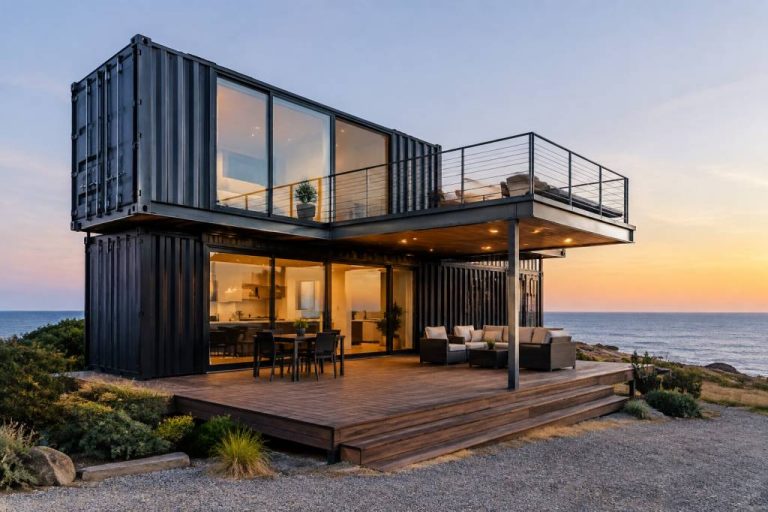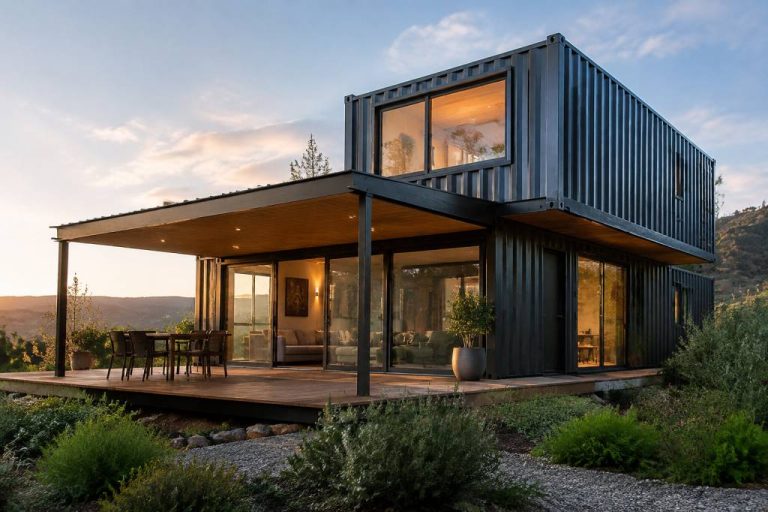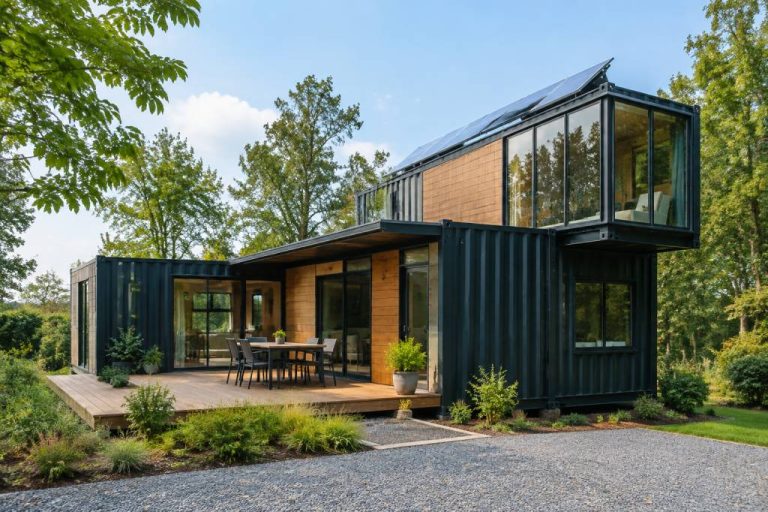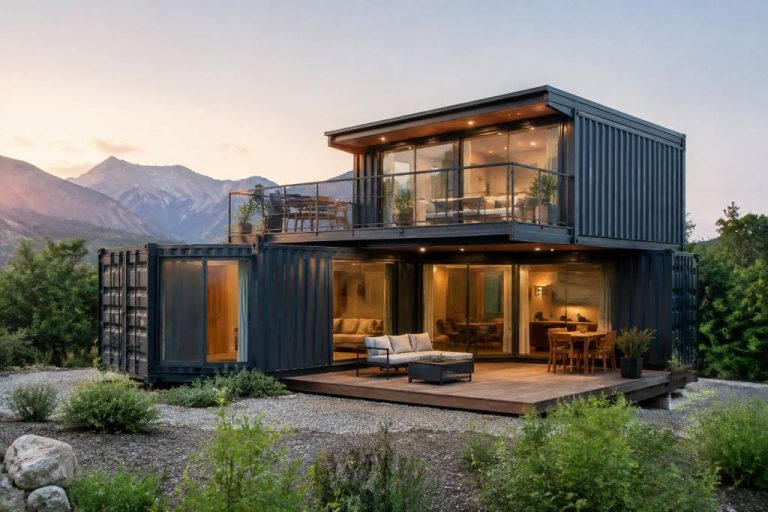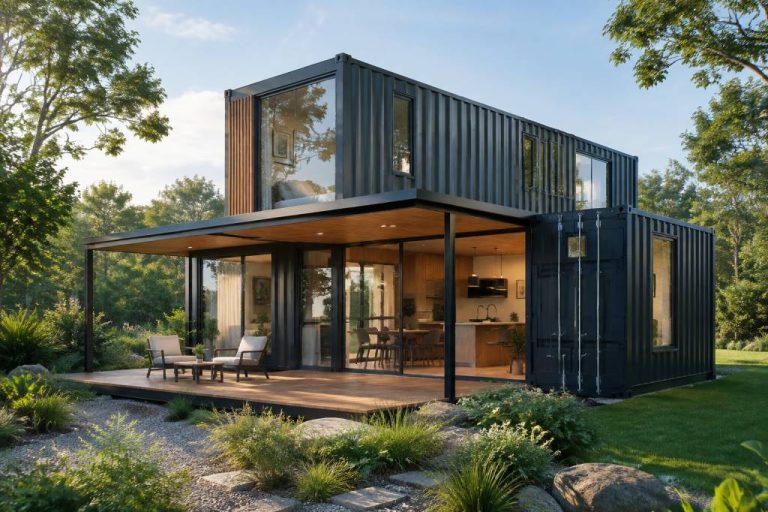

Green roofs and living walls on container houses to improve insulation and biodiversity
Can a steel box really become a cool, quiet, biodiverse mini-ecosystem? With a green roof and living walls, a container house gets closer to that ideal than most conventional builds. But unlike the inspirational images on Pinterest, a planted roof or façade on a container is above all une affaire de technique : charges, étanchéité, ponts thermiques, entretien. Mis au point correctement, ces systèmes améliorent nettement l’isolation, prolongent la durée de vie de l’acier et créent de vrais refuges pour la faune.
Why green roofs make particular sense on containers
A container house starts with three structural particularities:
- Thin, highly conductive steel walls and roof (2–3 mm)
- Edges and corners designed to take vertical loads, not the middle of the roof sheet
- Significant thermal bridges at every steel junction
As a result, even with good internal insulation, two problems remain: summer overheating under the steel roof and rapid temperature swings. A green roof tackles both.
Measured impacts on a metal roof are well documented:
- Surface temperature reduction: from 60–70°C on bare dark metal under summer sun to 30–35°C under a well-vegetated extensive green roof.
- Heat flux reduction through the roof: 60–90% lower in summer compared to non-vegetated metal, depending on substrate depth and moisture content.
- Acoustic damping: 5–15 dB reduction in rain impact noise, a non-negligible point for anyone who has spent a stormy night inside a bare container.
On top of that, green roofs offer ecological benefits that are often missing on compact container plots:
- Stormwater retention (30–80% of annual rainfall retained on the roof rather than sent to the sewer)
- Additional habitat for insects and birds when the plot itself has little uncovered soil
- Mitigation of urban heat island effect thanks to evapotranspiration and shading
In short, you gain thermal inertia, acoustic comfort and biodiversity where the container is naturally weakest: at the roof.
Types of green roofs suitable for container houses
For container architecture, two families of systems are usually relevant.
Extensive green roofs (the most common choice):
- Substrate depth: 5–15 cm
- Plant palette: sedums, low grasses, small perennials, drought-resistant species
- Approximate load (saturated): 60–150 kg/m²
- Maintenance: 1–3 visits per year (weeding, inspection, possible fertilization)
- Best suited for: single-story or stacked containers where access is possible but you don’t intend to use the roof as a terrace.
Intensive green roofs (more like a roof garden):
- Substrate depth: >20 cm, sometimes up to 1 m
- Plant palette: shrubs, small trees, vegetable beds, lawn
- Approximate load (saturated): 200–800+ kg/m²
- Maintenance: regular horticultural maintenance
- Best suited for: reinforced container structures designed from day one for these loads, usually with added steel beams or a secondary structure bearing the garden.
On a standard ISO container converted into a home, extensive systems are generally the only realistic option without substantial structural modification.
Structural reality: can a container roof carry a green roof?
The short answer: not without verification, and often not without reinforcement.
A shipping container is designed to carry heavy loads at its corners, not in the middle of the corrugated roof sheet. Typical data:
- Vertical stacking load at each corner: up to 86 kN (about 8.7 tonnes), by design.
- Uniform distributed load on the roof plate: usually only a few kN/m² in the manufacturer’s catalogue; climbing on the roof is allowed, storing a full roof garden is not.
For a simple extensive green roof on a 40 ft container (roughly 28–30 m² of roof):
- Green roof system weight saturated: 120 kg/m² (typical mid-range value)
- Total additional load: 30 m² × 120 kg ≈ 3.6 tonnes
Spread across the whole surface, this is not catastrophic, but you are no longer in the “lightweight” category. Several approaches are seen in well-documented projects:
- Adding transverse steel beams inside the container, welded to the top side rails, to reduce the span of the corrugated roof.
- Building a secondary independent steel frame over the container, resting on columns at the corners, and placing the green roof on this frame. The container roof then only serves as a weather skin, not as a structural element.
- Using high-profile steel decking or structural insulated panels (SIPs) as a replacement roof when the original roof is cut or removed.
Whatever the strategy, an engineer’s calculation is strongly advised. Many planning authorities now ask for a load justification when a living roof is added, particularly in snow zones.
Waterproofing and root barrier: non-negotiable layers
A steel roof has one great advantage: it is naturally watertight when intact. Unfortunately, the usual container conversion steps (cutting openings, welding flanges, adding roof penetrations) multiply risks of leaks. Under a green roof, a small leak can remain invisible for months but quietly corrode the steel.
A typical green roof build-up on a converted container looks like this (from inside to outside):
- Interior finish and vapor barrier (to manage condensation from the warm side)
- Thermal insulation (often PIR/PUR boards or mineral wool)
- Continuous waterproofing membrane (bituminous or synthetic, e.g. EPDM or TPO), carefully welded at joints and upstands
- Root barrier (separate sheet or integrated in the membrane depending on product)
- Protection and separation layer (geotextile)
- Drainage layer (dimpled sheet, mineral drain core, or plastic modules)
- Filter geotextile
- Substrate and vegetation
li>Existing steel roof panel, cleaned and treated with anti-corrosion coating
Key points for container projects:
- Avoid any direct contact between substrate and painted steel. Roots and constant moisture will quickly overcome standard container paints.
- Prefer membranes certified as root-resistant (FLL or equivalent testing) to avoid penetration along welds or joints.
- Pay special attention to edges: parapets, gutters, and transitions to container side walls must be properly flashed and accessible for inspection.
Inspections should be planned at least once a year, with particular attention to drains and any newly visible rust traces at the soffit or interior.
Thermal performance: what can you realistically expect?
A green roof does not make internal insulation obsolete; it complements it. For a container, performance gains are mainly visible in summer and mid-season.
Comparative data from studies on lightweight roofs:
- Peak internal ceiling temperature under a bare metal roof vs. under an extensive green roof can drop by 3–7°C in hot climates, assuming similar insulation thickness below.
- Daily temperature amplitude (difference between day’s max and night’s min) is reduced by 30–50% with a vegetated roof due to thermal mass and evapotranspiration.
- In cold climates, the additional R-value of a thin extensive green roof is modest (R ≈ 0.2–0.4 m²·K/W), but reduction of wind-driven heat loss and roof surface radiation still improves comfort.
For a typical container conversion with 120–160 mm of insulation under the roof, the green roof is a “booster” of thermal stability rather than a primary insulator. Where it really shines is when combined with well-designed shading, cross-ventilation and possibly night-time purging of heat.
Living walls on containers: systems and constraints
While green roofs tackle the horizontal plane, living walls act where containers most visually dominate: the façades. A container’s thin corrugated steel is a poor substrate for direct planting, but several systems adapt well.
Climbing plants on trellis (the simplest solution):
- Metal or wooden trellis or cable system fixed to a secondary frame, with an air gap between plants and steel (5–15 cm).
- Climbers in soil at ground level or in large planters.
- Thermal benefit: shading of the wall can reduce surface temperature by 10–20°C in summer.
- Advantages: low cost, simple maintenance, easy to repair or adjust.
- Risks: need to avoid direct fixing points that can pierce insulation or create condensation bridges.
Modular living wall panels (pre-fabricated trays with substrate and plants):
- Metal or plastic cassettes fixed onto a support rail system, independent from the container wall.
- Irrigation system integrated (drip lines, recirculation possible).
- Thermal benefit: shading + thin air layer + substrate adding some inertia.
- Advantages: high design control (plant palette, patterns), immediate visual effect.
- Risks: higher weight (40–80 kg/m² saturated), need for reliable irrigation and drainage, and more complex detailing at fixings.
Felt-based or pocket systems (hydroponic or low-substrate walls):
- Non-woven felt pockets irrigated from the top, roots anchored in a light medium.
- Very light initially, but saturated weight and water movement must be considered.
- More sensitive to irrigation failures and frost.
For container houses, climbing plants on a ventilated façade remain the most pragmatic option: they provide shading, visual softening and habitat with limited technical risk. Modular panels become interesting on specific, accessible façades where a higher design statement is sought.
Insulation and condensation behind a living wall
A living wall slightly improves thermal behaviour, but the main insulation strategy for a container should still be either:
- External insulation (ideal, but more complex to protect during construction), or
- Internal insulation with a continuous and correctly placed vapor barrier.
Adding a living wall on the outside changes the hygrothermal profile of the façade:
- Reduced solar gain on the steel means lower risk of overheating of the outer skin.
- Lower wind speed at the surface reduces convective heat loss in winter.
- Increased moisture presence (irrigation, transpiration) raises the importance of a well-ventilated gap between vegetation and steel and of corrosion-resistant coatings.
A minimum strategy that works well in practice:
- Keep a ventilated cavity between any living system and the steel cladding (horizontal or vertical battens creating a 20–40 mm gap).
- Use fixings that do not pierce through the insulation layer; where unavoidable, seal and thermally break them (sleeves, washers).
- Ensure bottom and top of the cavity are open to air to allow drainage and drying.
If external insulation is used, the living wall attaches to an outer rain screen or to an independent frame, not directly to the structural steel. This both protects the insulation and simplifies maintenance.
Biodiversity: what actually changes on a container plot?
A planted roof of 25–50 m² and one or two living façades will not “recreate a forest”, but data from urban ecology studies give some measurable trends:
- Pollinator presence: even simple sedum roofs increase visits from bees and hoverflies, especially if a mix of flowering species is included with staggered blooming periods.
- Bird use: green roofs offer feeding and resting zones for small birds; adding microhabitats (dead wood, small stones, insect hotels) further increases interest.
- Invertebrate diversity: substrates with varied grain size (fine + gravel + small rocks) and a mix of drought and moisture-tolerant plants host a wider range of spiders, beetles and other arthropods.
On container houses, where ground-level green space is often limited by access, parking and compact footprints, the vertical and horizontal surfaces are precious. Strategic choices increase ecological value:
- Prefer plant mixes over monocultures of sedum; include at least a few native species adapted to local conditions.
- Vary substrate depth slightly (5–12 cm) to create dry and slightly wetter zones.
- Leave some “wild” corners on the roof, not perfectly manicured.
- On façades, combine evergreen structure with seasonal flowering climbers.
These simple decisions transform a purely decorative system into a modest but real biodiversity asset.
Costs and maintenance: what owners should realistically plan for
Budgets vary by region and system complexity, but order-of-magnitude figures for Europe and North America are relatively stable.
Extensive green roof on a container (excluding structural reinforcement):
- Supply and install: 45–100 €/m² depending on size, access, and depth.
- Annual maintenance: 0.5–2 €/m²/year (if outsourced), more in the first two years.
- Structural studies and possible reinforcement: highly variable, from a few hundred euros for simple beams to several thousands for a full secondary structure.
Climbing plant façade with trellis:
- Trellis and fixings: 25–60 €/m² of covered façade.
- Plants and soil/planters: 15–40 €/m² equivalent.
- Irrigation (optional but recommended in hot climates): from a few hundred euros for a small, simple drip system.
Modular living wall:
- System and installation: 250–600 €/m², sometimes more for high-end or tall façades.
- Annual maintenance: significantly higher due to irrigation, fertilization and plant replacement.
From a life-cycle perspective, a well-built green roof can extend the life of the waterproofing membrane by protecting it from UV and thermal shocks, sometimes by a factor of 2. For a container where access to the roof is relatively easy, this can partially offset the initial investment.
Maintenance planning should include:
- Two inspections per year (spring and autumn) for green roofs: check outlets, remove invasive species, visually inspect edges.
- Monthly checks during the first growing season to ensure establishment and adjust irrigation if present.
- For living walls, seasonal pruning and an annual check of fixings and irrigation components.
Regulations, fire safety and practical constraints
Authorities are gradually integrating green roofs and walls into building codes and local planning rules. For container houses, three topics recur:
- Fire behaviour:
- Substrate composition matters; mineral-rich, non-combustible mixes with limited organic content are preferred.
- In dry periods, poorly maintained roofs can become fuel; some codes require vegetation-free strips around roof penetrations or between buildings.
- Access and safety:
- Roofs accessible for maintenance may require guardrails or at least anchor points.
- Living walls above public areas sometimes need protection against falling modules or saturated felt panels.
- Permits and visual impact:
- In some municipalities, a green roof can actually facilitate getting a permit for a container house, as it “softens” the industrial image.
- On the flip side, overly reflective membranes or bright plastic modules can be refused on aesthetic grounds; integrating them behind vegetation is one way around this.
An often overlooked point: access during construction. Many container plots are narrow or with limited crane access. Delivering substrate in big bags and hoisting them onto the roof before vegetation establishment simplifies logistics, but it requires anticipation at the design stage.
Design tips to integrate green roofs and living walls in container projects
To finish with a more practical angle, a few design principles emerge from the most convincing built examples:
- Plan structural support from day one. Even if the green roof is a “phase two”, design the frame (beams, secondary supports) early to avoid costly retrofits.
- Treat the green roof and living walls as part of the insulation strategy, not as afterthoughts. Coordinate with window placement, shading devices and ventilation paths.
- Keep all critical layers readable and accessible: steel, waterproofing, drainage and vegetation should each be identifiable and inspectable.
- Favor simplicity in plant choice. A robust, site-appropriate palette that can survive a week of irrigation failure is worth more than an exotic, fragile composition.
- Use the modular nature of containers to your advantage: a single “biodiversity module” (one container with intensive roof garden and full-height living wall) can compensate for more minimal siblings on the same plot.
In the end, the image of a container house half-hidden under vegetation is not just a marketing argument. When well designed, green roofs and living walls address several of the intrinsic weaknesses of steel modules: thermal instability, acoustic harshness, and ecological sterility. The technical bar is higher than for a simple felt roof or painted façade, but the payoff—in comfort, durability and biodiversity—is, in many cases, worth the engineering effort.
À propos de l'auteur