


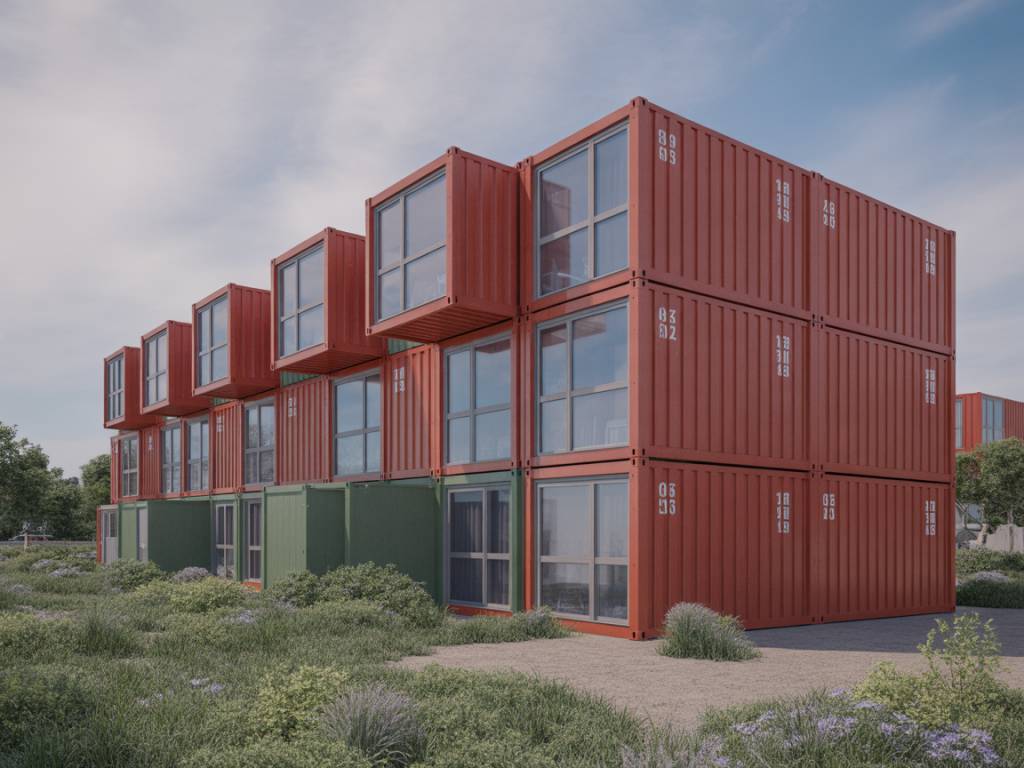
From “temporary boxes” to regulated homes
Fifteen years ago, most planning officers saw shipping containers as site cabins or pop-up cafés. Today, they’re approving multi-storey student residences, social housing and single-family homes built entirely from steel boxes.
This shift isn’t seulement esthétique. Behind the images on Instagram, building regulations have been quietly catching up. Codes that never mentioned containers now start to integrate them under “modular”, “relocatable” or “industrialised” construction. Others create explicit routes for “reused structural components”.
For anyone planning a container-based project, the real question is no longer “Is it allowed?” but “Under which regulatory framework will it be judged, and at what cost in time, études techniques and certification?”
Why container housing puts pressure on existing codes
Most building regulations were written around conventional, on-site construction with new materials. Containers disrupt that logic on four fronts:
- Reuse instead of new steel: A container is a second-hand, standardised steel shell. Structural design must account for unknown history (impacts, corrosion, fatigue).
- Industrialised off-site process: Much of the work is done in factory conditions. Many codes still assume “chantier” logic, not assembly of pre-certified modules.
- Non-traditional envelope: Thin corrugated steel, thermal bridges everywhere, sometimes unknown paints or fumigation residues.
- Mobility and stacking: Containers are designed to be stacked 6–9 high at sea, but not necessarily with large side openings, balconies or roof terraces cut into them.
Result: regulators are forced to answer questions that the code doesn’t always detail explicitly. What is the fire resistance of a modified container wall? How do you treat a reused box in a life-cycle assessment? Which Eurocodes or US standards apply when you weld several containers together?
How codes are reclassifying container homes
The first regulatory evolution has been semantic: how do we name a container house in legal terms?
Depending on the country, the same object may be treated as:
- a “temporary building” or “relocatable unit”,
- a “modular prefabricated system”,
- a conventional “steel-framed building” using “reused elements”,
- or, in the most advanced cases, a specifically recognised “container-based construction system”.
This classification has immediate consequences on energy requirements, fire safety, accessibility and even foundations. A few examples show the direction of travel.
North America: from case-by-case approvals to model code language
In the US and Canada, most container projects are evaluated under existing structural and modular frameworks, but the tools are becoming more explicit.
1. Structural and fire regulations
Building officials typically use the International Building Code (IBC) or International Residential Code (IRC) as a baseline. Containers are often treated as “steel-framed” structures complying with:
- ANSI/AISC 360 for steel design,
- ASCE 7 for loads (wind, snow, seismic),
- NFPA 5000 / NFPA 101 for fire and life safety where applicable.
The evolution is mainly procedural: several US states now accept “third-party modular certification” for container modules built in factories. Instead of each project proving from zero that the box is safe, the manufacturer gets system-level approval (structural, fire, electrical, plumbing), and the local authority focuses on foundations and site-specific aspects.
2. Energy codes catching up with thin steel shells
Energy codes like IECC 2021 or ASHRAE 90.1 don’t mention containers, but they hit them hard. A bare container wall is an excellent radiator; continuous insulation is almost always mandatory.
Many jurisdictions now accept performance-based paths: instead of meeting prescriptive R-values per assembly, you can prove with an energy model (e.g., EnergyPlus) that the overall building meets or exceeds code performance. For container projects, this approach is increasingly used to justify:
- external insulation systems on the steel shell,
- high-performance glazing offsetting limited wall thickness,
- advanced HVAC with heat recovery to compensate for geometric constraints.
Europe: containers inside modular and circular economy frameworks
In Europe, regulations are more fragmented but a few trends are clear: industrialised construction and circularity are now explicit policy objectives.
1. Containers as part of industrialised “off-site” construction
Several EU countries have integrated off-site and modular approaches into their building regulations or technical guidelines. Containers usually fall under this umbrella.
- France: container systems are assessed by organisations like CSTB through Avis Techniques or ATEx. Once a system is validated (fire, structure, thermal, acoustics), subsequent projects are easier to approve.
- Netherlands / Scandinavia: container housing often enters the regulatory process as “factory-made modules”. The project is assessed against Eurocodes (EN 1990–1999) with specific attention to connections between modules and disproportionate collapse.
This shift means more pressure on manufacturers to provide structural calculations, material traceability and fire test reports up front—but less uncertainty for architects and clients.
2. Circular economy and “reused components”
The EU’s push on circularity is slowly translating into building codes and public procurement rules. Some national frameworks now include or are testing:
- requirements or incentives for a percentage of reused materials,
- simplified approval paths for products with documented origin and properties,
- life-cycle assessment (LCA) obligations, where the low embodied carbon of reused containers becomes a measurable asset.
This is where container projects gain a regulatory advantage: when you can show that the primary steel shell is reused and properly decontaminated, the project can score better in LCA and, in some cases, qualify for public funding or higher sustainability labels.
UK and Australia: from pop-up to permanent housing
United Kingdom
In the UK, container buildings must comply with the Building Regulations in the same way as conventional buildings. The evolution is mainly in interpretation:
- Part A (Structure): containers are treated as steel structures. Once side walls are cut, engineers design additional framing to regain stiffness and justify robustness against disproportionate collapse, especially for multi-storey student or co-living schemes.
- Part B (Fire safety): high-profile fires have pushed regulators to be stricter on external fire spread, cavity barriers and non-combustible external insulation. This directly affects typical container cladding build-ups.
- Part L (Conservation of fuel and power): new versions of Part L require better thermal performance and airtightness, making ad-hoc container conversions harder to certify without detailed U-value calculations and blower-door tests.
The clear trend is toward treating container housing as fully permanent stock, particularly in the social and student sectors. “Temporary” classifications are now more tightly defined in time and conditions of use.
Australia
In Australia, the National Construction Code (NCC) does not explicitly list container buildings, but several states have issued guidance for “shipping container buildings and structures”. The pattern is similar:
- containers used briefly on farms or as storage may be exempt or lightly regulated,
- containers used as dwellings fall fully under the NCC, including energy efficiency provisions (Section J),
- fire and cyclone/wind loading requirements lead to more stringent structural detailing and anchoring systems.
From one-off experiments to system certification
Perhaps the most important evolution is procedural. Early container houses were essentially bespoke prototypes: each one required custom calculations, ad-hoc fire engineering, sometimes painful negotiations with the local authority.
Today, regulators are pushing the market toward repeatable, certified systems rather than heroic one-offs. Three trends stand out.
1. Factory audits and “type approval”
Many jurisdictions now offer some form of “type approval” or “system approval” for container-based products:
- the manufacturer gets audited (welding procedures, material sourcing, QA/QC),
- a set of standard container modules is tested (fire, acoustics, structural),
- the result is a certificate or report that local building officials can rely on without re-opening every question.
For project owners, this reduces the design and permitting time and creates more price predictability. For regulators, it shifts risk analysis earlier in the chain, at the industrial level.
2. Performance-based routes replacing prescriptive dead-ends
Because containers rarely fit prescriptive rules (for example, exact wall thicknesses or cavity depths), several codes are formalising performance-based routes: if you can prove through testing, simulation or recognised engineering methods that you meet the functional objective (fire resistance, energy performance, structural safety), you can deviate from prescriptive details.
In practice, this has enabled:
- fire-engineered solutions to protect modified container walls without over-specifying incombustible heavy materials everywhere,
- thermal solutions combining internal and external insulation to manage thermal bridges practically,
- mixed structures (containers + timber or light steel framing) in the same building.
The flip side is cost: performance-based design requires expertise, test reports and software models. Regulators are increasingly explicit about documentation standards, which raises the design bar for small DIY conversions.
Health, contamination and indoor air: a new focus
One of the weakest points of early container conversions was the near-total absence of checks on the containers’ past life. Paints, fumigation treatments and chemical spills were often ignored.
Regulations and technical guidelines are starting to move on this subject:
- Some countries now require proof that original flooring and hazardous coatings have been removed or encapsulated with certified systems.
- Indoor air quality regulations (e.g. VOC limits, radon, ventilation rates) apply exactly as in conventional housing, pushing designers to think more seriously about mechanical ventilation in these highly airtight steel boxes.
- Certain public housing agencies now demand traceability of containers (last cargo, fumigation history) or opt for “one-trip” containers to avoid uncertainties, despite the higher embodied carbon compared to deeper reuse.
Here again, the regulatory trend is clear: a container house is a house first and a container second. Health and comfort requirements no longer tolerate “it’s just a box, it’ll be fine”.
Planning rules: when is a container “temporary”?
Beyond building codes, another battlefield has been urban planning and zoning. Many early projects tried to avoid full compliance by claiming “temporary” status. Regulators are now narrowing that window.
Common evolutions include:
- Time limits: permits for temporary container housing are limited to a fixed number of years, after which full compliance with permanent standards is required or the modules must be removed.
- Usage restrictions: certain zones allow “temporary worker housing” or “event-related accommodation” in containers, but not long-term residential occupancy.
- Visual integration: planning conditions frequently address façade treatment, rooflines and landscaping, pushing container projects to move beyond the raw industrial aesthetic.
For developers, the key shift is that “temporary” is no longer a structural shortcut; it’s a clearly regulated status with obligations for dismantling, site restoration and sometimes deconstruction plans for the containers themselves.
What this means for architects, builders and self-builders
The regulatory evolution does not make container housing easier in every respect. It makes it clearer. The romantic era of “weld two boxes together and call it a tiny house” is over in most developed markets. In its place, we see a more demanding but more predictable framework.
Before starting a project, three questions structure the regulatory strategy:
- Permanent or temporary? If your real intention is permanent housing, designing to temporary standards is now a regulatory and financial dead end in many jurisdictions.
- One-off custom build or standardised system? If you plan to replicate the design, it often makes sense to invest early in system-level certification and factory audits.
- Reuse logic or “container-shaped” new modules? Some manufacturers now produce new modules inspired by container dimensions but engineered and certified explicitly as building products. They navigate the regulatory landscape more easily but lose part of the reuse narrative.
Practical checklist for navigating evolving regulations
For a container-based housing project launched today, a few pragmatic steps significantly reduce regulatory friction:
- Engage the building official early: present preliminary sketches, intended use (duration, number of occupants), container type and level of modification. Clarify how the project will be classified (modular, temporary, permanent steel building).
- Ask manufacturers for documentation up front: structural calculations, fire test reports, details of insulation assemblies, certificates for paints and coatings. If they cannot provide them, budget for external engineering and testing.
- Plan for complete decontamination: remove or encapsulate original floors, verify absence of hazardous residues. Treat this as a non-negotiable health and compliance item.
- Design envelope and services to meet current energy codes: assume continuous external insulation, high-performance windows and mechanical ventilation with heat recovery will be necessary for full compliance.
- Separate what can be “standard” from what is “project-specific”: repeatable container modules with fixed details are easier to certify once and reuse across projects. Site works (foundations, stairs, access, fire-fighting) remain project-specific.
- Document the reuse story quantitatively: if your jurisdiction values circularity, prepare basic LCA data: avoided emissions from reused steel, end-of-life scenarios, disassembly potential. This increasingly influences planning and funding decisions.
As building regulations continue to evolve, container housing will look less like a loophole and more like one option among many in the industrialised construction toolbox. The projects that navigate this new landscape best are not necessarily the most spectacular, but those that treat the container not as a shortcut, but as a component that must justify, point by point, its performance, its cost and its environmental relevance.