


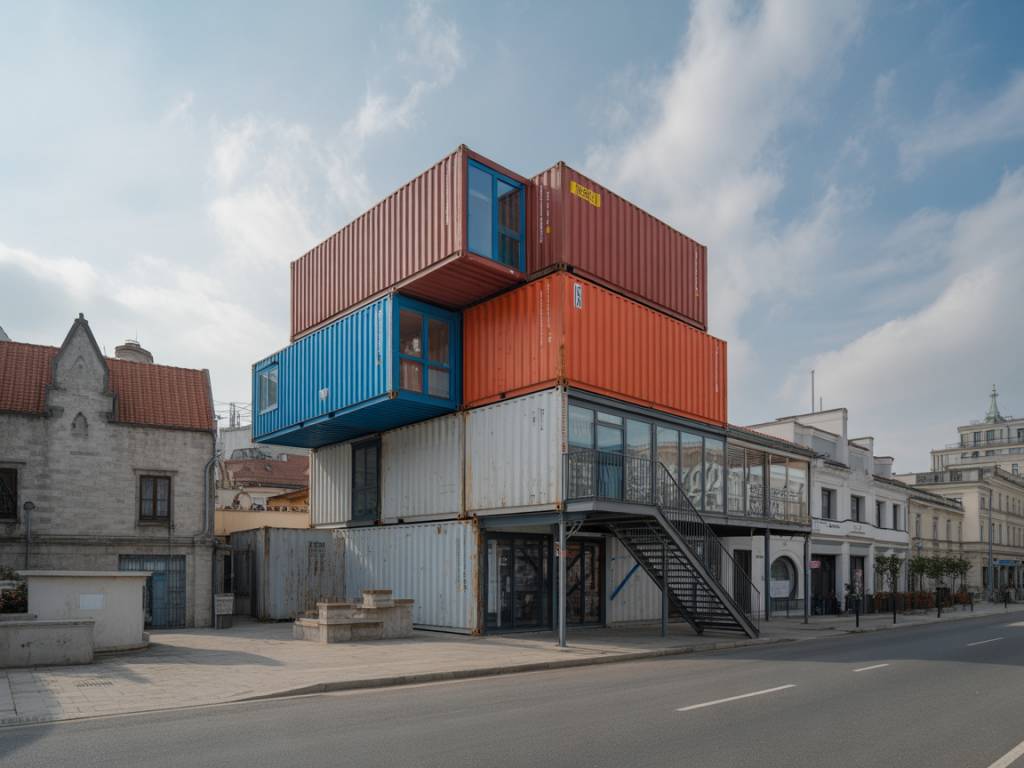
Hybrid buildings that blend traditional structures with stacked shipping containers are no longer architectural curiosities. From small extensions to full multi-storey developments, architects are using containers as structural modules, infill volumes or rooftop additions grafted onto more conventional frames in concrete, timber or steel.
What do these mixed-typology projects change in terms of structure, costs, insulation, fire safety or planning permission? And, above all, dans quels cas le container est-il réellement pertinent par rapport à une extension maçonnée classique ou à une surélévation en bois ?
What do we mean by “hybrid container architecture”?
In practice, most projects labelled “container houses” are already hybrids. The containers rarely work alone: foundations are concrete, stairs are steel, partitions are timber, façades are insulation plus cladding.
Here, by hybrid structures, we will focus on buildings where:
- shipping containers are visibly or structurally stacked, and
- they are combined with a different primary system: masonry walls, reinforced concrete frame, heavy timber, or light steel framing.
Typical configurations include:
- Container rooftop extensions on existing masonry or concrete buildings, often set back from the street façade.
- Container wings or side extensions attached to a traditional house, acting as a new living room, studio or rental unit.
- Hybrid cores where containers form only part of the volume (e.g. bedrooms), plugged into a timber or steel frame hosting stairs, circulation and services.
- Mixed-use complexes combining a concrete podium (parking, commercial) with several levels of container-based housing or offices above.
The interest of these hybrids is not aesthetic only. They address very practical constraints: structural capacity of existing buildings, speed of construction on occupied sites, reuse of materials, and phasing of works in dense urban fabrics.
Why combine containers with traditional structures?
Purely container-based projects are often limited by three issues: span, height, and regulatory perception. Hybrids allow architects to bypass some of these limits.
1. Structural efficiency where it matters
Shipping containers are optimized for vertical stacking at the corners and for loads in transit, not for large interior spans or concentrated loads in the middle of a wall. When you need:
- large open-plan spaces (living rooms, coworking areas), or
- high vertical circulation cores (stairs, lifts),
a conventional frame in concrete or steel generally does that job faster and with fewer compensations. Containers then become “plug-in” rooms where their dimensions (approx. 2.35 m wide, 2.4–2.9 m high, 6 or 12 m long) are an advantage rather than a constraint.
2. Managing loads on existing buildings
For rooftop extensions, the first question is: how much extra weight can the existing structure carry? A typical 40′ high-cube container weighs around 3.8 t empty. Once insulated, fitted out and loaded with occupants and furniture, design loads in Europe commonly sit around 2.5–3.0 kN/m². Compared to a conventional masonry addition, a lightweight container + steel system is often easier to bring within the reserve capacity of older concrete or brick buildings.
3. Speed and disturbance on site
On occupied sites, especially in urban areas, time and noise are the primary enemies. Stacking two or three pre-fitted containers on an existing slab in one day, then connecting them to a pre-built services core, can drastically reduce:
- time spent with scaffolding on the street,
- dust and noise for residents,
- weather-related delays on finishes.
Hybridization means you can prefabricate container modules off-site while the traditional structure (foundations, cores, retaining walls) is under construction, and then interlock the two on a compressed schedule.
4. Regulatory readability
In several jurisdictions, planners and building control officers are still cautious with 100% container projects, especially above certain heights or in protected areas. A hybrid scheme where:
- the primary frame is fully compliant with conventional standards, and
- containers are treated as steel modules integrated into that frame,
is often easier to justify from a code standpoint (fire, seismic, acoustic, durability).
Three typical project scenarios
To understand the real constraints, it is more useful to look at scenarios than at “iconic” projects only.
Rooftop extension on a 1960s concrete building
Imagine a four-storey reinforced-concrete building from the 1960s, neat but unremarkable. The owner wants one additional level of housing. Two main technical issues arise:
- Can the existing slabs and columns take the extra load?
- How to build without evacuating the occupants?
A hybrid solution might consist of:
- a lightweight steel frame screwed or welded to the existing structure, redistributing loads to the most robust columns,
- two rows of 40′ high-cube containers stacked as “boxes” sitting on this new frame,
- a non-container central strip containing the stair and lift extension in steel and plasterboard, which is easier to fire-rate than a modified container wall.
Technically, the main difficulties are not where one might expect:
- Structural interface: verifying that local punching shear in existing slabs is kept under control where new posts bear, often by adding steel spreader beams.
- Thermal bridging: continuous steel from old structure to new containers can create significant linear thermal bridges; thermal breaks or insulated shoes are needed at key junctions.
- Acoustics: impact sound transmission from the rooftop units to the apartments below must meet residential standards. This often implies a “box-in-box” floor buildup inside the containers: floating screed or acoustic batten system, not just a thin plywood floor.
In return, the gain is significant: installation of the containers and main frame can be done within a few days, with most noisy works concentrated in structural connections, not in masonry.
Side extension to a detached house
Second scenario: a family house in masonry, needing an extra living room and a home office. The extension could be in brick or timber frame, but the owners have access to two retired 20′ containers.
A coherent hybrid design often looks like this:
- masonry or concrete strip foundation, dimensioned for the container loads,
- containers placed to form the core volume, partially cut to open towards the existing house,
- a timber or light steel roof that oversails both containers and the old façade, resolving the continuity of insulation and water-tightness.
Key points from realised projects:
- Do not rely on the container roof alone. Corrugated steel sheets of containers are thin and not designed for heavy loads or long spans. A separate roof structure (timber or steel) gives much better control over insulation thickness, airtightness and integration of roof lights or PV.
- Accept the dimensional grid. Trying to force containers into irregular plans leads to a lot of cutting, welding and loss of structural efficiency. In hybrid domestic projects, treating the container volume as one or two rectangular “rooms” and letting the non-container parts handle irregularities is generally more economical.
- Thermal alignment at the junction between old wall and new container volume must be drawn precisely. The steel shell is highly conductive; insulation continuity must wrap around cut edges, with attention to condensation risks.
Mixed-use building: concrete podium, container levels above
Finally, the most “urban” hybrid: a concrete base with commercial space and parking, topped by several levels of container-based offices or micro-apartments. Here, the hybridization is primarily driven by:
- clear fire separation between uses,
- robustness against vehicle impact and dampness at ground level,
- speed and modularity for upper floors.
Structurally, the concrete podium acts as a transfer slab. Above, containers are:
- stacked in a grid respecting their corner-post alignment,
- laterally braced by the concrete cores or additional steel bracing,
- connected to each other and to the slab with welded or bolted corner fittings.
What does this change compared to an all-concrete frame?
- Programme flexibility: container modules can be swapped or added later, especially if circulation cores and services shafts are independent.
- Weight reduction: superstructure weight may decrease by 20–30% compared to a fully concrete frame, which can reduce foundation loads.
- Façade strategy: in many successful projects, containers are almost completely wrapped in external insulation and cladding. From the street, you see a contemporary façade; inside, you benefit from modular repetition of rooms based on container dimensions.
Technical challenges specific to hybrid structures
The mix of systems is not free of trade-offs. Several recurring issues appear on nearly all hybrid projects.
1. Continuity of structure
Containers are fundamentally four corner posts tied together by thin steel plates. The moment you cut large openings in the sides to connect to a masonry wall or create open spaces, you alter their structural logic.
In hybrids, engineers must verify:
- load paths between traditional structure and containers (no “hanging” corners on thin sheet metal),
- global lateral stability: the combination of shear walls, braced frames and container stacks must resist wind and seismic forces,
- local reinforcements: frames around cut openings to restore stiffness, often with box sections welded to the container’s top and bottom rails.
2. Insulation and condensation control
Mixing heavy, slow-to-heat masonry and thin, fast-reacting steel shells in the same building envelope is a recipe for thermal heterogeneity if not detailed carefully.
Common strategies include:
- External insulation on containers whenever planning rules allow it, to keep the steel inside the warm envelope and reduce condensation risks.
- Continuous insulation layers across junctions between container and traditional walls, often in the form of mineral wool or PIR boards that “wrap” the interfaces.
- Vapour control adjusted to climate: in cold-temperate zones, a well-sealed vapour control layer on the warm side of container insulation is essential to avoid condensation on the back of steel panels.
3. Fire safety
Steel containers behave differently from concrete or massive masonry in fire. They can lose stiffness and deform relatively quickly when not protected. In hybrids exceeding two or three storeys, regulatory requirements typically push towards:
- fire-rated linings (plasterboard systems) inside containers to protect the steel for the required period (e.g. 30–60 minutes),
- compartmentation strategies that may treat each container as a fire cell, or group of cells, with fire-stopped joints at connecting walls,
- separate escape stairs and protected routes often housed in non-container cores for greater predictability and easier certification.
Each interface between container and traditional structure is a potential weak point (cavities, hidden gaps, penetrations for services). Detailing and inspection here are non-negotiable.
4. Acoustics
A bare container wall has very low mass compared to a concrete wall. Without additional layers, both airborne and impact noise will fall far below residential or office comfort targets.
Effective hybrid solutions tend to combine:
- “wet” screeds or high-mass dry floor systems inside containers, often on resilient layers,
- double-skin walls (container steel + independent stud frame + insulation + double plasterboard) to achieve sufficient sound reduction,
- decoupling details at junctions between container modules and the heavier traditional structure to avoid acoustic bridges.
Cost, carbon and schedule: when does hybridization make sense?
Numbers vary widely by country and by availability of used containers, but several patterns emerge from realised projects and cost plans.
Cost
On small residential projects, using one or two containers rarely brings a radical reduction in total cost. The price of:
- modifying the containers (cutting, welding, sandblasting, painting),
- bringing them to regulatory standards (insulation, fire, acoustics),
- crane operations on site,
can quickly approach the cost of a well-run timber-frame extension, per m². The main economic benefits appear when:
- the number of identical modules increases (repetition effect),
- off-site prefabrication is optimized (services factory-installed, interior finishes completed),
- site constraints make conventional masonry slow and expensive (tight urban sites, very short allowed work windows).
Carbon footprint
Reusing containers often looks ecologically obvious. In reality, the balance depends heavily on:
- whether the containers are truly being reused instead of scrapped, or diverted from other uses (storage, logistics),
- the extent of modifications: heavy steelwork and new steel sections can offset part of the reuse benefit,
- the insulation and cladding strategy: thick mineral wool and durable claddings can be low-carbon, but high levels of PIR/PUR boards may not.
Hybrid systems allow combining:
- containers where their reuse is most efficient (repetitive, small rooms),
- low-carbon materials elsewhere (timber frames, cellulose insulation, lime plasters).
The result can be favourable compared to an all-concrete frame, especially on upper levels, but gains are project-specific and should be supported by a life-cycle assessment, not just intuition.
Schedule
Where hybrid systems excel is in overlapping phases:
- foundations, cores and traditional structure on site,
- container conversion, insulation and partial fit-out in workshop,
- rapid on-site assembly with minimal wet trades at height.
On projects above 500–800 m², it is not unusual to shave several weeks off the critical path compared to a purely site-built solution, provided the design is frozen early enough for factory production.
Is a hybrid container project right for you?
For owners, architects and builders, the relevant question is not “Do we want containers?” but “Where do containers genuinely add value in this specific project?” A few pragmatic filters help:
- Site constraints: restricted access, busy surroundings, or stringent schedule? Hybrid container modules can be an asset.
- Programme: repetitive small rooms (student housing, micro-apartments, hotels) are well-suited; large open spaces are better carried by traditional frames.
- Existing structure: limited reserve capacity? Lightweight container additions with steel framing may fit where a heavy masonry or concrete extension would not.
- Regulatory environment: local familiarity with modular construction and clear guidance on fire and acoustics for steel modules strongly influence feasibility.
- Design discipline: willingness to work within the container grid and accept certain dimensions and junctions as givens is essential to avoid cost escalation.
Hybrid structures are not a shortcut around the technical demands of contemporary construction; they are a different way to distribute them. Traditional architecture brings mass, inertia and regulatory familiarity. Containers bring precision, speed and modularity. When the interface between the two is carefully engineered – structurally, thermally and acoustically – the result is not a compromise but a composite system that takes the best of both worlds.