


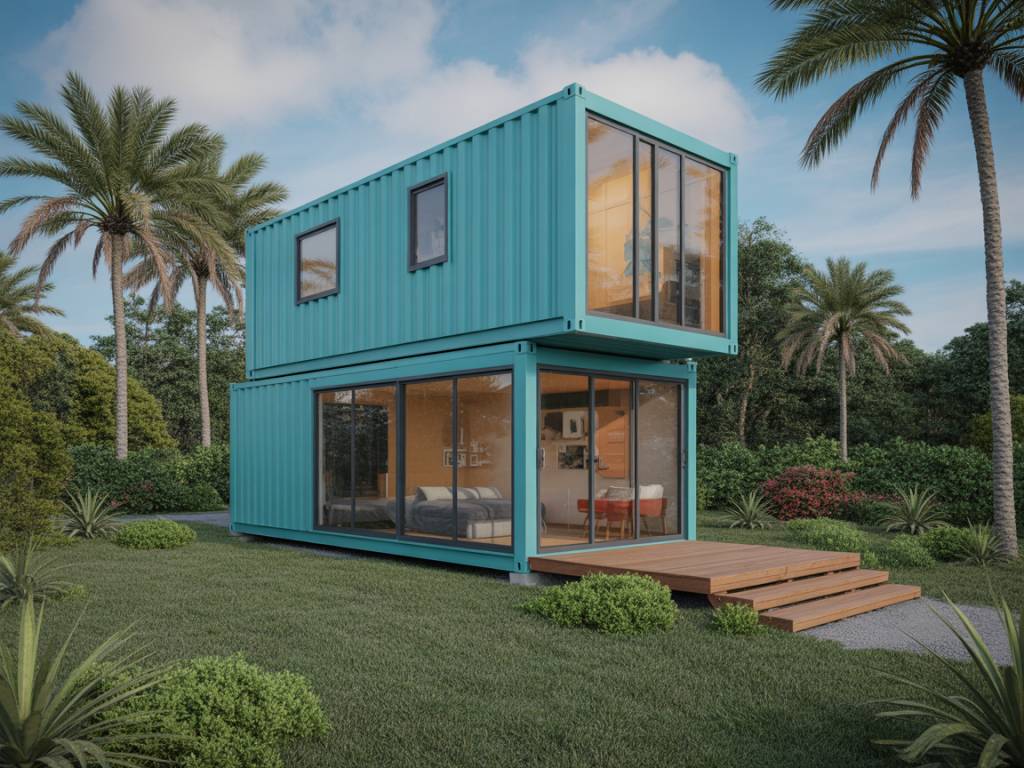
Why smart tech matters more in a container house
In a conventional house, a poorly tuned heating system ou un éclairage énergivore sont souvent tolérés pendant des années. In a container house, that same lack of control shows up immediately: temperature swings faster, humidity spikes, and every kWh counts. The compact, highly conductive steel shell amplifies both the strengths and weaknesses of the building.
That’s exactly where smart home technology becomes less of a gadget and more of a structural ally. Properly chosen and configured, connected systems can:
- Compensate for the low thermal inertia of steel modules
- Optimise heating, cooling and ventilation in very compact volumes
- Reduce peak loads on small electrical installations often found in modular builds
- Provide granular monitoring to validate the performance of insulation and airtightness
This article looks at concrete, proven smart technologies that actually improve comfort and efficiency in container houses – and skips the decorative tech that mainly adds complexity.
Start with the envelope: sensors are your first “smart” device
Before talking about connected thermostats or voice assistants, the first step is to understand how your container behaves. Lightweight modular structures react quickly to external conditions. A change in solar gain or wind exposure translates into a temperature shift in minutes, not hours.
Simple, reliable sensors are therefore the backbone of any serious smart setup:
- Temperature sensors in each “zone” (living area, bedroom, bathroom, technical space). In a 2–3 container house, that usually means 3 to 5 sensors.
- Humidity sensors, especially in bathrooms and kitchens, where condensation risk against steel surfaces is high if ventilation is inadequate.
- CO₂ sensors in main living spaces. In airtight modular constructions, CO₂ is a good proxy for indoor air quality and ventilation needs.
- Energy meters on main circuits (heating, hot water, general sockets, EV charger if any). Sub-metering reveals which area or appliance drives the bills.
In practice, a simple wireless sensor ecosystem (Zigbee or Z-Wave, for example) connected to a central hub is often enough. Several container projects in Europe now integrate this from day one of the build, not as a “later upgrade”, to allow the monitoring of the house during the first winter and adjust insulation details or ventilation settings with real data instead of impressions.
Smart heating and cooling: managing a fast-reacting shell
Heating and cooling are where smart control yields the clearest gains in a container house, because the envelope responds quickly. The residence does not have the thermal mass of thick masonry to buffer temperature changes. That is an advantage if you control it well, and a problem if you do not.
Connected thermostats and zoning
In many modular container houses, electric solutions are common: heat pumps (air-to-air or air-to-water), electric underfloor heating in thin slabs, or infrared panels. All benefit from precise control.
- Zoned thermostats in each container or functional area (day/night zones) avoid heating unused spaces, which is especially relevant in modular designs where a guest module may only be occupied a few weeks per year.
- Learning thermostats (that adapt to the thermal inertia of the building) are particularly effective because the container envelope heats up and cools down quickly. Systems like this can anticipate by a few minutes rather than hours.
- Remote control is not just a convenience: for weekend or holiday container houses, being able to pre-heat or pre-cool before arrival avoids leaving the system running in “frost protection” mode all week.
Integrating heat pumps and ventilation
Many high-performance container houses pair a compact heat pump with mechanical ventilation with heat recovery (MVHR). Smart control can coordinate the two:
- Reduce ventilation flow when outdoor air is extremely cold or hot, while maintaining minimum hygienic rates.
- Increase flow automatically during cooking or showers when humidity sensors detect peaks.
- Use CO₂ levels to boost ventilation only when occupancy really requires it.
A French project of a 60 m² two-container house in the Alps reported up to 20–25% reduction in heating demand simply by linking MVHR boost modes to humidity and presence sensors rather than using fixed timer programs. The hardware was identical; only the control strategy changed.
Lighting: from “on/off” to adaptive comfort in small spaces
In compact interiors, lighting has a disproportionate impact on perceived comfort. It can also impact overheating: poorly placed, non-dimmable LED spotlights near the ceiling of a container will not generate much heat, but they will still add to the cooling load in summer.
Daylight first, then smart controls
The best “smart” lighting strategy in a container house starts with daylight: generous openings, correctly oriented, with shading. Once that is fixed, automation can refine rather than compensate:
- Presence detectors prevent lights staying on in small rooms like bathrooms or corridors.
- Ambient light sensors adjust artificial light according to the real contribution of diffuse daylight through the container’s openings.
- Tunable white LEDs change colour temperature throughout the day (cooler in the morning, warmer in the evening), useful in deep container layouts where access to natural light is limited.
Simple scenes instead of complex scripts
For most owners, a handful of clearly named scenes is more useful than dozens of automated rules. In a 3-container family house, typical use cases include:
- “Morning” scene: gentle ramp-up of bedroom and kitchen lighting, slight increase of temperature in living areas, pre-heating of hot water if solar production is high.
- “Away” scene: all non-essential sockets off, heating set-back, security system armed, exterior lights in randomised pattern in the evening.
- “Summer night” scene: cross-ventilation enabled (motorised windows or vents open), interior lights limited to low-level pathways to avoid attracting insects and overheating.
In a container, where spaces flow into each other, scenes help manage multiple zones without multiplying switches on already limited wall surfaces.
Smart ventilation and condensation control: critical in steel structures
Behind the steel skin of a container house, condensation is a constant risk. Even with proper insulation and vapour control layers, uncontrolled humidity can find its way to cold surfaces. Smart ventilation is therefore not just about comfort; it protects the structure.
Humidity-driven ventilation
Instead of relying only on fixed-flow fans, humidity-based control offers a more contextual approach:
- Humidity sensors in bathrooms and near kitchen zones trigger boost extraction only when needed.
- Data logging helps identify recurring issues (for example, a specific cold bridge where surface temperature is too low) when combined with occasional thermal imaging.
- In off-grid or low-energy setups, avoiding continuous high-speed ventilation preserves battery capacity without sacrificing indoor air quality.
Smart windows and vents
Some recent container conversions integrate motorised windows or façade vents controlled by the central system. Typical logics:
- Night-time free cooling in summer: if outdoor temperature is at least 2–3°C lower than indoor and humidity is acceptable, vents open automatically.
- Protection mode in storms: if strong wind and rain are detected (via a roof sensor), rooflights and vents close to avoid water ingress, a risk heightened by large cut-outs in container roofs.
- Fire safety: in certain jurisdictions, automated opening for smoke extraction can be integrated with the smart system, though this must respect local codes and be fail-safe.
This type of automation is particularly relevant for multi-container assemblies where natural cross-ventilation is harder to achieve due to internal partitioning.
Energy management: where smart tech meets small-scale infrastructure
Many container houses experiment with off-grid or hybrid configurations: PV on the roof, small battery systems, sometimes a generator. Even when fully grid-connected, the electrical infrastructure is often more compact than in a traditional home. Smart energy management here is not optional; it keeps the system within its limits.
Sub-metering and load monitoring
Installing connected energy meters on key circuits yields immediate benefits:
- Identifying silent consumers such as always-on devices, underfloor heating left in “comfort” mode, or electric towel rails.
- Preventing overload of limited supply lines by shedding non-essential loads (for instance, temporarily cutting the EV charger when the heat pump starts).
- Analysing seasonal patterns to validate insulation performance: if heating demand is systematically higher than modelling predicted, it may reveal a construction defect (missing insulation, unsealed junctions, etc.).
Smart integration of solar and storage
The roof area of a container is well suited to PV: flat, modular, often unobstructed. Smart systems can optimise its use:
- Run high-consumption appliances (washing machine, dishwasher, water heater boost) when PV production is high, either automatically or with user prompts.
- Keep a reserve of battery capacity for evening comfort rather than letting the battery fill at midday and sit idle.
- Export to grid only when local consumption is covered and battery is at an optimal state of charge, according to the tariffs in place.
Several off-grid container cabins in Northern Europe now rely on relatively modest battery banks (5–10 kWh) made viable thanks to smart scheduling rather than oversizing the entire system.
Security, access and monitoring: specific to modular and remote sites
Container houses are often installed in remote or semi-remote locations: coastal plots, forested land, brownfield sites awaiting redevelopment. Security and remote monitoring therefore play a double role: protecting the building and providing operational data.
Access control and occupancy
- Smart locks reduce the need for physical key management, especially in multi-module rental complexes or co-living schemes based on containers.
- Door and window sensors feed data about real occupancy patterns into the energy management system, allowing for more accurate “away” modes.
- Temporary codes or app-based access simplify site management during construction and commissioning phases where multiple trades need access at different times.
Remote diagnostics
A properly instrumented container house can send alerts well before a human would notice a problem:
- Unusual drop in internal temperature during a cold spell, indicating a heating failure or open window.
- Persistent high humidity in a specific wall or ceiling cavity (with embedded sensors), signalling a possible leak.
- Repeated tripping of a circuit breaker detected by the smart energy meter, pointing toward an electrical fault.
For modular projects delivered turnkey, builders increasingly offer a remote monitoring package for the first year. This allows them to adjust control parameters and catch defects early, while building a dataset for future designs.
Choosing the right protocols and infrastructure for steel boxes
A recurring technical question: does the steel structure of containers interfere with wireless communications? The answer is nuanced. Yes, the metal shell attenuates signals, but in most residential configurations, the issue is manageable with simple design choices.
Wired where it matters, wireless where it is flexible
- For fixed equipment (heating controllers, MVHR, PV inverters, main sensors), running low-voltage data cables (Ethernet or dedicated bus) during the build is the most robust option. The additional cost is marginal if planned early.
- For mobile or easily repositioned devices (room thermostats, battery-powered sensors, switches), wireless protocols like Zigbee, Z-Wave or Thread work well when the hub is centrally located.
- Where signal is weak between modules, adding repeaters or running a single wired backbone between containers and placing wireless hubs in each module solves most issues.
Local control first, cloud services second
Many consumer smart devices rely heavily on cloud connectivity. For container houses in areas with unreliable internet, or off-grid cabins, this is not ideal. A few practical criteria help select resilient systems:
- Devices must be able to operate autonomously on a local hub or gateway if the internet connection is down.
- Critical functions (heating, ventilation, security) should not depend on external servers or subscriptions.
- Data storage on a local controller facilitates long-term analysis, which is particularly useful for architects and engineers evaluating the real performance of modular constructions.
Costs, complexity and where to start in a container project
For many future owners, the risk is to treat smart home tech as an afterthought, or conversely as a shopping list of gadgets. In the specific context of container houses, a staged, performance-oriented approach works better.
Phase 1: infrastructure and sensors
- Plan wired connections for heating, MVHR, PV and key sensors during design and fabrication of the modules.
- Install basic environmental sensors (temperature, humidity, CO₂) in each main zone from day one.
- Set up sub-metering for major circuits in the electrical panel.
Phase 2: essential control
- Add smart thermostats and link them to presence and window sensors for simple, robust control.
- Implement humidity-based ventilation boosts in wet rooms.
- Create a small number of clear, practical scenes (away, night, summer) rather than automating everything.
Phase 3: optimisation and services
- Integrate PV and storage with load management if applicable.
- Enable remote monitoring and data logging for at least a year to assess real performance.
- Only then consider additional layers (voice assistants, advanced scenarios) if they bring tangible value.
In terms of budget, field experience on recent European container projects shows that a coherent, performance-oriented smart system (excluding PV and batteries) typically represents 3–7% of the total build cost. Above that, you are often paying for comfort features and brand names rather than energy or structural benefits.
Used intelligently, smart home technology does exactly what a good container architecture aims for: maximum function in minimum volume, with systems that work harder in the background so occupants can think less about knobs and settings, and more about how they want to inhabit their steel-framed space.