


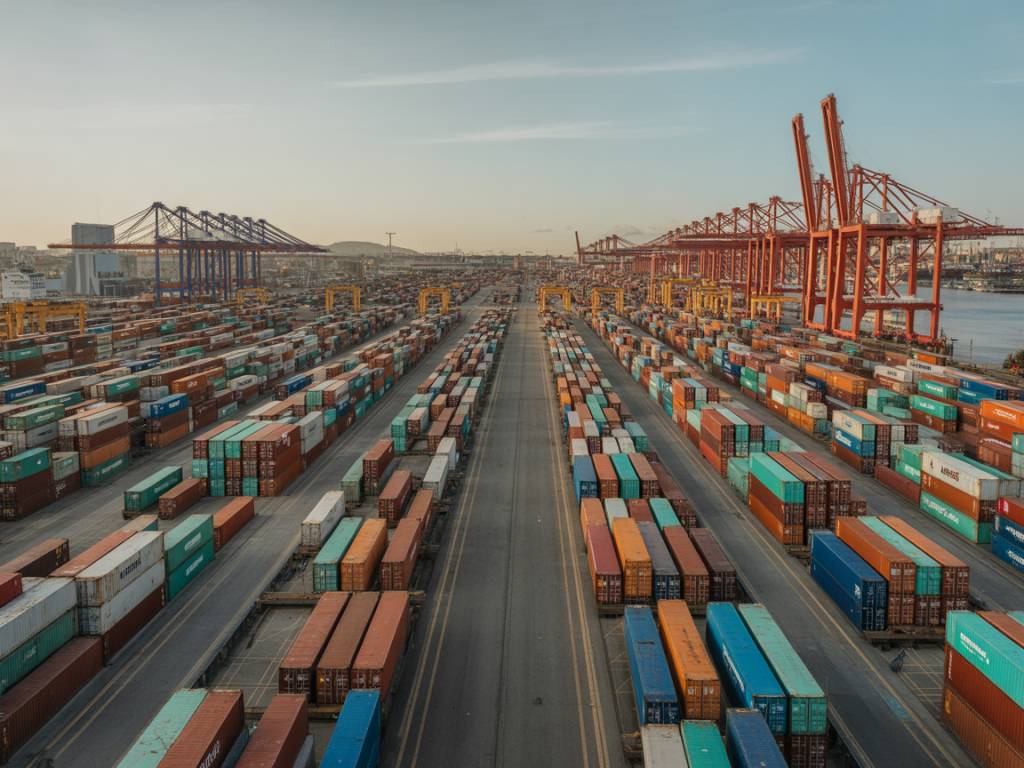
Across Europe, North America and parts of Asia, ports are shrinking while their hard infrastructure remains: hectares of paved ground, redundant cranes, disused warehouses and, often, rows of retired shipping containers. For cities confronting housing pressure and derelict industrial land, these sites are no longer just a planning headache. Used intelligently, they can become the backbone of new container-based neighbourhoods.
This is not a theoretical exercise. From Amsterdam’s NDSM wharf to London’s Trinity Buoy Wharf and Christchurch’s post-earthquake Re:START village, former port or logistics areas have already hosted container projects at various scales. But transformer un ancien terminal maritime en quartier vivable exige autre chose qu’un alignement de boîtes colorées. It forces you to address structural constraints, ground pollution, insulation performance, fire strategy, governance and long-term adaptability.
Let’s walk through how a disused shipping yard can move from brownfield to a functioning container neighbourhood, and what architects, developers and self-builders should really anticipate before sketching the first module.
Why shipping yards make good (and difficult) testbeds
On paper, old shipping yards tick several boxes for container-based urbanism:
- Existing hardstandings and load-bearing ground – Wharf slabs and container stacking areas are designed for point loads far above a typical house. A standard 40 ft container loaded for sea can reach 30–32 tonnes; yards are dimensioned accordingly. This can reduce foundation costs for stacked housing.
- Direct relevance of container typology – The site’s history legitimises the use of containers. Residents are usually more accepting of an “industrial” aesthetic in a former port than in a historic centre.
- Large, contiguous surfaces – It is easier to plan micro-mobility, public space, green corridors and mixed uses when you start with tens of thousands of square metres of uninterrupted asphalt.
- Existing access and utilities – Railway spurs, heavy-duty road access and proximity to the grid are already there. Upgrading is cheaper than creating from scratch.
However, the same history comes with constraints:
- Soil contamination – Hydrocarbons, heavy metals, PFAS and other pollutants are common under old storage slabs and fuel depots. This impacts what can be planted, dug or infiltrated on site.
- Noise and risk from remaining port activities – Where the container yard is only partially disused, risk assessments (Seveso-type in Europe) may limit residential uses or impose robust acoustic and safety strategies.
- Monofunctional zoning legacy – Planning documents often still classify these areas as “industrial”. Converting to mixed-use or residential requires a full re-zoning procedure.
Any realistic masterplan must start from this double reading: structural opportunity versus environmental and regulatory baggage.
From stacked boxes to a neighbourhood grid
A disused yard is typically a rectangular expanse organised by container stacking logic: rows, lanes, reachstacker circulation. That geometry can be a constraint or a design tool.
Several successful projects use three basic rules to progress from “stacking field” to neighbourhood:
- Keep the container logic for structure, not for urbanism – Design the urban grid (streets, plazas, green corridors) first, then “fit” containers into that framework. If you let old stacking patterns dictate everything, you end up with the ergonomics of a storage facility, not a district.
- Work with 3–5 storeys as a default – Containers can structurally stack far higher, but fire regulations, circulation complexity and the need for light and air make mid-rise modules more realistic for housing. Above five levels, you are effectively in “tower” territory with different regulations and cost profiles.
- Alternate solids and voids – For every block of stacked containers, plan a void: a courtyard, garden, shared terrace or atrium. This is essential for daylight, cross-ventilation, social interaction and mitigation of the thermal inertia of large metal surfaces.
On the Trinity Buoy Wharf site in London, for instance, the architecture team used containers for live-work units up to four levels high but preserved generous circulation decks and shared terraces. The result is dense, but not claustrophobic. Critically, the public realm is designed first; the container clusters plug into it.
For former shipping yards, a practical approach is to map three layers:
- Structural layer – Where is the ground strong enough for 5–6 stacked units? Where are existing foundations, tracks, culverts?
- Risk and noise layer – Where are noise peaks, residual freight lines, hazardous neighbours? These areas might host workshops, parking or buffer uses rather than bedrooms.
- Climate layer – Sun path, prevailing winds, flood risk. These inform the orientation of container rows, balcony placement and green infrastructure.
The intersection of these layers gives you “safe zones” for residential clusters, “buffer zones” for commercial and “sacrificial zones” for parking, logistics or events space.
Container typologies: standard, high-cube or hybrid modules?
Even on a port site rich in steel boxes, the choice of container type is not trivial once you move into permanent housing or offices.
The main options are:
- Standard 40 ft used containers (2.59 m high) – Cheapest and most abundant. After interior insulation and technical voids, net ceiling height can drop to 2.20–2.25 m, which is acceptable but not generous. Good for studios, student housing or technical spaces.
- High-cube 40 ft containers (2.89 m high) – 300 mm extra internal height offers much more flexibility for overhead services and insulation. Often 10–20% more expensive than standard used units, but this premium is usually justified for residential comfort.
- New-built container-like modules – Fabricated off-site with the same corner-casting logic, but with optimised wall sections (e.g. integrated insulation, pre-framed openings). More expensive upfront but can save labour on site and perform better thermally.
In the Amsterdam NDSM redevelopments, a mix of new-built modules and used containers is common: “true” containers for workshops and artist studios, purpose-built modules for longer-term residential units. This hybrid strategy lets the site visually reference its port heritage while not sacrificing comfort in the most sensitive programmes.
On a large yard, you might for example decide that:
- Ground-floor commercial and maker spaces use reconditioned standard containers with minimal insulation where large openings reduce the metal envelope anyway.
- Upper-floor housing uses high-cube or new-built modules with thicker insulation and integrated service voids.
Material selection for the modules themselves should be coordinated with the energy strategy: there is no point saving 500 € per container if you then overspend on heating or cooling for 40 years.
Insulation: from metal box to habitable envelope
Transforming a former yard into a neighbourhood is as much an insulation problem as an urban planning one. Bare containers are essentially uninhabitable in most climates: too hot in summer, too cold in winter, prone to condensation.
Three key decisions drive performance:
- Inside vs. outside insulation
- Type of insulation material
- Continuity of the thermal envelope across joined modules
On old port sites, external insulation often offers the best compromise. Sprayed or panelised insulation on the outside preserves interior space and reduces thermal bridging through the steel frame. For example:
- External rockwool panels (120–160 mm) behind a ventilated façade (metal, fibre-cement, timber). Good fire performance, robust, recyclable.
- Wood fibre or cork panels where a biobased profile is desired. Lower embodied energy, improved phase shift (slower heat transfer in summer), but thicker and often costlier.
- Closed-cell spray foam – Efficient thermally and good for awkward geometries, but problematic from a fire, recyclability and VOC standpoint if used extensively. Increasingly scrutinised by regulators.
For European climates, target U-values for walls in a container neighbourhood typically fall around 0.15–0.25 W/m²K. Achieving this with steel and limited thickness requires careful detailing. On multi-container assemblies, the priority is continuity: every junction where two modules meet is a potential thermal bridge and condensation risk.
Practical check-list for container insulation on a yard redevelopment:
- Treat the container roof as a priority – Solar gain and rain noise are significant. Consider adding a secondary roof with insulation and integrated PV rather than over-insulating the original corrugated sheet from inside.
- Introduce a ventilated cavity between cladding and insulation – This increases durability and helps manage moisture.
- Use non-combustible insulation (A1 or A2-s1,d0) for multi-storey residential clusters; local regulations increasingly demand this anyway.
- Detail window reveals and balcony fixings to limit cold bridges. In a steel-dominated envelope, these small details add up.
Several projects on former industrial land use container roofs as collective technical platforms: insulation above, then PV, solar thermal, sometimes green roofs. This turns what could be a thermal weakness into an energy asset.
Materials and recycling: leveraging the yard’s DNA
Cities often promote container neighbourhoods as examples of circular economy: “We are reusing port infrastructure and surplus containers.” That narrative only holds if the material strategy goes beyond painting some old boxes in bright colours.
On a disused yard, there is typically a large stock of recoverable materials:
- Decommissioned containers – Those still structurally sound can be repurposed; others can be cut for cladding, stair cores, awnings or acoustic barriers.
- Steel from cranes and gantries – Heavy beams and columns can support canopies, walkways or public art rather than being scrapped.
- Timber from pallets and crates – Often low-grade, but usable for non-structural cladding, interior finishes or temporary constructions.
- Aggregates from broken concrete slabs – Recycled in new foundations, drainage layers or permeable pavements.
Setting up an on-site “urban mining” workshop can make sense for large sites. Containers that are too damaged to be used as modules are dismantled; their sheet steel is cut and flattened; structural members are catalogued. In Hamburg and Copenhagen, several port-adjacent projects have used such workshops not just as a resource hub but also as a training and employment tool.
The goal is to create a material gradient:
- Primary structural modules – Only the best containers or new-built elements.
- Secondary structures and cladding – Reclaimed port steel, re-cut shipping containers, recycled plastic boards.
- Landscape and public realm – Reused bollards as benches, old rails as edging, crushed concrete as aggregate.
This approach not only reduces embodied carbon; it visually anchors the new neighbourhood in its port identity without falling into pastiche.
Regulation, fire safety and long-term legality
One recurrent mistake in container neighbourhood projects is to treat them as “temporary” even when everyone knows they will likely stay for decades. Former shipping yards often provide political breathing space for experimental projects, but residents reasonably expect the same safety and legal protection as in conventional districts.
Three regulatory domains are non-negotiable:
- Structural safety – Stacking containers higher than two or three levels for inhabited uses requires a full structural design, not just reliance on ISO corner castings. Once you modify walls and cut openings, the original load paths are no longer valid.
- Fire safety – Route widths, external escape stairs, compartmentation between units, façade reaction to fire, separation distances between blocks. Metal enclosures can heat up rapidly, and cladding/insulation choices are critical.
- Building codes and energy performance – Even if the urban planning document classifies the ensemble as “temporary”, most jurisdictions require that permanent housing meets standard performance baselines.
On large redevelopments, an effective strategy is to define from the outset which clusters are genuinely temporary (5–10 years) and which are intended as long-term. Temporary clusters might host cultural programmes, pop-up retail, student housing or incubators with simpler servicing and potentially lower performance targets. Long-term clusters must be designed like any other building, only with a modular chassis.
The Re:START container village in Christchurch is a textbook case: conceived as a temporary response after the 2011 earthquake, it operated for several years but was ultimately dismantled as more permanent structures came online. The regulatory framework was explicit from day one; this avoided the grey zone that plagues many “provisional” container complexes which quietly become permanent slums.
Energy, microclimate and open space on a former yard
Old container terminals are typically devoid of trees, shade and permeability. Asphalt rules, water runs off, wind accelerates between stacked elements. Turning such an environment into a comfortable neighbourhood is a microclimate design challenge.
Priority interventions include:
- De-sealing and soil remediation patches – Instead of removing all hard surfaces, target strategic cuts in the slab to introduce planted strips, rain gardens and infiltration basins. This helps with both stormwater management and heat-island reduction.
- Layered shading – Combine container overhangs, pergolas made from reclaimed steel, lightweight canopies and trees (where soil depth allows). Avoid relying solely on vegetation in areas with contaminated or shallow soil.
- Roofscape as a fifth façade – On multi-storey container clusters, the roof field is often the main solar asset. Photovoltaics, reflective coatings, green roofs and communal terraces can coexist if planned early.
Energy systems on such sites can exploit the existing industrial-scale connections:
- District heating or cooling if near industrial waste heat or a harbour geothermal loop.
- Shared plant rooms housed in containers or refurbished port buildings, feeding several residential blocks.
- On-site generation via PV on roofs and south-facing façades. Metal roofs and clear spans simplify mounting.
In Rotterdam’s Merwe-Vierhavens area, for example, interim container projects are being connected progressively to a lower-temperature district heating network fed partly by industrial sources. Temporary-looking modules thus plug into an infrastructure sized for long-term, denser development, limiting stranded assets.
Governance and adaptability: avoiding the “shipping yard ghetto”
The urban and technical design of a container neighbourhood can be excellent on day one and still degrade rapidly if governance is an afterthought. Former shipping yards often sit outside traditional residential management cultures; port authorities, logistics companies and municipalities must learn to co-manage a mixed-use district.
Two issues are particularly sensitive:
- Mix of tenures and uses – If the whole site ends up as mono-functional low-rent container housing, the risk of stigmatisation is high. Maintaining a balanced mix of workshops, cultural venues, offices, student units and family housing is key.
- Maintenance of the metal envelope – Containers need periodic inspection for corrosion, seal failures and mechanical damage. A shared maintenance fund and technical standards help avoid a patchwork of improvised repairs.
Adaptive design principles can mitigate these risks:
- Use standardised module dimensions and connection details so that units can be swapped, extended or reconfigured with minimal disruption.
- Design ground floors as robust, high-clearance spaces that can oscillate between storage, workshops, retail or community use over time.
- Reserve at least one “flex zone” on the site for experimental uses, seasonal events or future densification; do not saturate the yard on day one.
Several northern European projects have found that pairing container housing with maker spaces or cultural programmes changes the social perception of the entire district. What could have been seen as a “cheap metal estate” becomes a hub for production, art and nightlife, with housing integrated instead of isolated.
What to check before you propose a container neighbourhood on a shipping yard
For architects, developers or public authorities considering such a transformation, a pragmatic due diligence grid might look like this:
- Site and ground – Detailed contamination study; structural survey of slabs; flood and sea-level projections; noise and risk mapping.
- Regulation – Current zoning; port authority rights; hazard installations nearby; building code constraints for modular steel structures.
- Material and module strategy – Availability and condition of used containers; need for new-built modules; on-site recycling potential; preferred insulation systems.
- Energy and infrastructure – Capacity of existing grid connections; opportunity for district heating/cooling; stormwater management concept; mobility plan (public transport, cycling, logistics).
- Urban programme – Target population mix; balance of housing, workspaces and public facilities; phasing scenarios for progressive occupation.
- Governance – Long-term ownership model; maintenance responsibilities; participation of residents and local actors in governance structures.
Disused shipping yards will not all become flagship container neighbourhoods. Some will remain pure logistics backlands; others will transition to more conventional real estate. But for cities willing to align material pragmatism, robust engineering and long-term governance, they offer a rare combination: strong ground, industrial heritage and the possibility to prototype new modular urban forms at scale.
If you approach them not as blank slates, but as complex, resource-rich infrastructures to be carefully reprogrammed, containers stop being a visual gimmick and become what they are structurally designed to be: reliable, stackable units in a much larger system.