


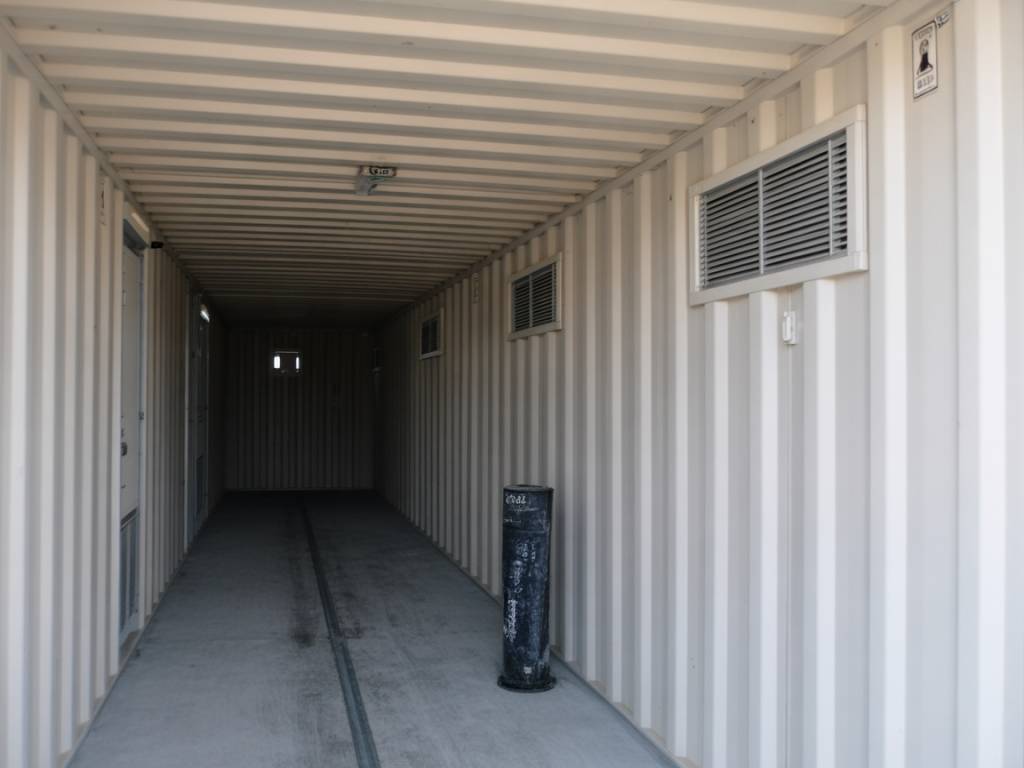
Why insulated containers turn into condensation traps
Insulating a shipping container without planning ventilation is a bit like putting a thick winter jacket on and then taping it shut at the neck and wrists. Yes, you’re warm; no, the moisture inside has nowhere to go.
A standard 20’ or 40’ steel container is:
- Perfectly airtight once doors and seals are in good condition
- Made of thin steel, with very low thermal inertia
- Highly conductive: thermal bridges at every stud, frame and junction
As soon as you add insulation and interior finishes, you change the way the container behaves thermally and hygrothermally. The interior becomes more comfortable, but water vapour produced by occupants and activities (cooking, showers, drying clothes) gets trapped. In a small volume – typically 15–30 m³ for tiny units, 60–75 m³ for larger ones – even 2–3 people can easily generate more than 5–8 litres of water per day.
Without a clear path to evacuate this humidity, you see the classic symptoms:
- Condensation on cold steel surfaces behind the insulation
- Black mould at thermal bridges (corners, around windows, along ceiling joints)
- Swollen or degraded insulation and interior lining (especially plasterboard, MDF, OSB)
- Corrosion of the container shell where condensate accumulates
Ventilation is therefore not optional. In an insulated container, it is a core part of the design, just like the insulation itself or the structural modifications.
Understanding the physics: where and why condensation appears
Condensation occurs when warm, humid indoor air meets a cold surface. In container projects this happens in three main zones:
- On the inner face of the steel shell, when insulation is placed on the inside and the vapour barrier is discontinuous or poorly sealed.
- On metal frames and studs used as substructure for cladding, especially if they are fixed directly to the container walls.
- On window and door reveals, where insulation thickness is reduced and thermal bridges are hard to avoid.
To prevent this, any ventilation strategy must combine three levers:
- Limit humidity production (behaviour, appliances)
- Extract humid air efficiently at the source (kitchen, bathroom, laundry)
- Provide a continuous background air change to keep the overall humidity below critical levels (ideally 40–60% RH)
The good news: you have several levels of solutions, from very low-tech passive vents to compact heat recovery units designed for micro-dwellings. The right mix depends on climate, use and budget.
How much ventilation does a container actually need?
For a container converted into living space, most European guidelines and good practice documents point to:
- Continuous air change rate of 0.3–0.5 air changes per hour (ACH) for the whole volume
- Higher specific rates in “wet” rooms:
- Kitchen: 30–60 m³/h (continuous) or 90–120 m³/h (intermittent boost)
- Bathroom: 30–60 m³/h
- Utility / laundry: 30–60 m³/h when in use
For a 40’ High Cube fitted out as a small home (about 67 m³ of internal volume), 0.5 ACH means roughly 30–35 m³/h of continuous fresh air. That is achievable with simple passive vents, but in cold or hot climates, energy losses make mechanical options more attractive.
Passive ventilation solutions: simple, robust, but limited
Passive systems rely on pressure differences (wind, stack effect) to move air. In containers, their main advantage is simplicity and almost zero maintenance.
Basic wall vents and trickle vents
The most common option is to install small through-wall vents and window trickle vents.
- Wall vents:
- Typically 80–125 mm diameter, with exterior grille and interior baffle
- Should be placed:
- High on dry room walls (living, bedroom) for extract or outlet
- Low or mid-height, on the “windward” and “leeward” sides, to benefit from cross-ventilation
- Use models with insect mesh and condensation-resistant materials (PVC or powder-coated aluminium)
- Window trickle vents:
- Integrated into the frame or sash of new windows
- Provide a small, controllable air inlet even when the window is closed
- Useful for bedrooms and living rooms that do not have a dedicated mechanical system
On their own, these devices are rarely enough to deal with high moisture loads from showers and cooking. They are best used in combination with mechanical extract fans.
Stack effect: using height and warm air to your advantage
A container does not offer much height, but if you stack or place it under a higher roof, you can use stack effect to generate flow.
- Roof vents:
- Fixed or rotating cowls installed through the roof panel
- Prefer double-skinned models with thermal break to reduce cold spots
- Need careful flashing and sealing to prevent leaks, especially with ribbed container roofs
- Combined strategy:
- Low-level inlets on the long facades
- High-level outlets on the roof or upper walls
- Works best in climates with significant indoor-outdoor temperature differences
For off-grid storage containers with minimal occupancy (workshops, micro-depots), this can be sufficient to control condensation on tools and materials. For full-time living units, passive-only approaches tend to be too weather-dependent.
Mechanical extract: the minimum for habitable containers
If there is one place where you cannot compromise, it is the bathroom of an insulated container. A single daily shower can release 1–2 litres of water into the air. Without extraction, that moisture migrates into the rest of the unit.
Bathroom and kitchen extract fans
In most cases, the base configuration that works is:
- Bathroom:
- Axial or mixed-flow fan, 60–90 m³/h, ducted through wall or roof
- Timer overrun (10–20 minutes after light is off) or humidity sensor (trigger at 60–70% RH)
- Backdraft damper to prevent cold air entering when off
- Kitchen:
- Cooker hood vented to the outside, with minimum 120 m³/h effective flow for a small container kitchen
- Avoid recirculating-only hoods in small, tight spaces – they remove grease, not moisture
These fans must be paired with dedicated air inlets in the same rooms or adjacent spaces, otherwise the system will simply depressurise the container and pull cold air through random leaks (or not work at all if the shell is too airtight).
Continuous low-flow extraction
Instead of high-flow intermittent fans, several manufacturers offer “continuous trickle” extract fans, running at 5–15 m³/h most of the time and boosting when humidity rises. For a container, this approach has two advantages:
- Maintains a stable air change rate, limiting background humidity build-up
- Reduces noise peaks and draught sensation often associated with powerful intermittent fans
When paired with high-level inlets in dry rooms, this effectively turns the container into a small, simple mechanical exhaust ventilation (MEV) system.
Heat recovery ventilation: when energy efficiency matters
In cold or very hot climates, simply bringing outdoor air in and dumping warm or cool indoor air out is energetically expensive. This is where small-scale mechanical ventilation with heat recovery (MVHR/HRV) becomes relevant.
Single-room HRV units
For containers, the most practical devices are through-the-wall single-room heat recovery units:
- Installed in a 100–160 mm core-drilled hole through the wall
- Typical flow rates: 15–60 m³/h
- Heat recovery efficiency: 70–90%, depending on model and conditions
- Low power consumption: 3–15 W
- Integrated filters and often humidity or CO₂ sensors
Placed in the main living / sleeping area, they provide:
- Tempered incoming air, reducing cold draughts near windows
- Stable background ventilation without significant heating penalty
- Some noise attenuation compared to simple vents (depending on model)
Bathrooms and kitchens can keep simple extract fans, while dry rooms benefit from the HRV unit. This hybrid configuration works especially well for off-grid or low-energy container homes in temperate to cold regions.
Small centralised MVHR for multi-container projects
For larger assemblies (two or three containers combined), a compact central MVHR with short duct runs becomes realistic. Key points to watch in a steel shell:
- Use insulated ducts wherever they cross cold zones (suspended ceilings, service voids next to the outer steel skin)
- Plan penetrations through the container early in the structural design; cutting holes through corrugated walls and frames after fit-out is risky and costly
- Provide accessible filter locations – dusty sites and coastal environments clog filters faster than you might expect
On real projects, a correctly sized MVHR unit has consistently shown:
- Interior RH maintained between 40–55% even in winter with four occupants
- Noticeable reduction of surface mould on cold bridges compared to identical units with only intermittent extract fans
- 20–30% lower heating consumption compared to simple exhaust systems (figures vary by climate)
Dehumidifiers: useful backup, poor substitute for ventilation
Portable dehumidifiers are often suggested as a “quick fix” for condensation in containers. They have their role, but also clear limits.
What they can do well:
- Reduce indoor RH quickly in very humid climates or after a “wet event” (leak, plastering, fresh screed)
- Help during the first months of occupation while the container fit-out is still drying
- Provide backup in off-grid or low-power situations when mechanical ventilation cannot run continuously
What they cannot do:
- Replace fresh air supply – CO₂ and VOCs still accumulate without ventilation
- Address localised cold spots where condensation forms behind insulation
- Run reliably in very cold technical voids (most units are rated for 5–35°C)
In practice, a dehumidifier is a complement: useful in winter in very small or over-occupied containers, but not a core strategy.
Ventilation and insulation: getting the build-up right
No amount of ventilation will fully compensate for a poor wall/roof build-up. In containers, two recurring errors are responsible for hidden condensation and mould:
- Interior insulation without a continuous vapour barrier:
- Mineral wool between metal studs, with perforated or poorly taped plastic sheeting
- Result: warm humid air penetrates the lining, cools against steel, condenses, remains trapped
- Rigid foam glued directly to steel with unsealed joints:
- EPS or PIR panels adhered to the shell, but with gaps at panel edges, around frames and at corners
- Result: localised condensate at junctions, streaking corrosion on steel over time
To reduce the risk:
- Prefer continuous insulation layers with limited thermal bridges (e.g. spray foam or carefully detailed rigid boards)
- Install a proper vapour control layer on the warm side, fully taped at joints and around all penetrations
- Use timber battens rather than steel studs where possible to limit cold bridges
- Design services (electrics, plumbing) in a service void inside the vapour barrier to avoid puncturing it
Ventilation then becomes the second line of defence, keeping the overall indoor humidity at a level where occasional minor defects do not systematically trigger condensation.
Climate and use: adapting the ventilation strategy
A container yoga studio in Lisbon does not need the same solution as an off-grid micro-home in rural Sweden. Three parameters drive the design:
- Climate:
- Cold and humid: prioritise controlled mechanical ventilation with some form of heat recovery, careful insulation detailing
- Warm and humid: favour strong extract and cross-ventilation, possibly with supplemental dehumidification; HRV less effective if indoor-outdoor temperature delta is small
- Hot and dry: focus on shading, night-time purge ventilation, possibly evaporative cooling; condensation risk is lower but still present in bathrooms and kitchens
- Occupancy:
- Occasional use (office, studio): intermittent mechanical extract plus passive inlets may be adequate
- Permanent residence: continuous background ventilation almost always needed
- High-density use (tiny homes, student modules): design for high moisture loads, consider HRV for comfort and energy
- Energy source and autonomy:
- Grid-connected: MVHR and smart fans are easier to justify
- Off-grid: look at low-power fans (DC, solar-assisted), simple passive paths, and careful behaviour (shorter showers, covered cooking)
Retrofitting ventilation in already insulated containers
Many readers face a common scenario: the container is already fitted-out, mould has appeared, and opening the walls feels like a nightmare. What can be done realistically?
- Start with diagnostics:
- Measure indoor RH and temperature over several days with a simple data logger
- Check CO₂ at peak occupancy if possible – this reveals lack of fresh air even if humidity looks acceptable
- Use a borescope or small inspection holes in discreet locations to inspect behind linings
- Add mechanical extract first:
- Install a proper bathroom fan if none exists, vented directly to exterior
- Upgrade kitchen extraction to a ducted hood where feasible
- Create controlled air inlets:
- Retrofit wall or window vents in dry rooms, even if it means some disruption
- Ensure at least one low-resistance air path per main room
- Consider a single-room HRV:
- If energy losses or draughts are a major concern, a through-wall HRV unit in the most occupied room can transform comfort and mould risk
- Only then decide on opening up walls:
- If, after several weeks of improved ventilation, you still see mould and corrosion progressing, the insulation/vapour barrier build-up is probably flawed and needs partial reconstruction
Operation and maintenance: small habits, big impact
Even the best-designed ventilation system will fail if it is never cleaned, filters are clogged and occupants disable it because of noise or perceived drafts. A practical checklist for container users:
- Run bathroom and kitchen fans during and at least 15 minutes after showers or cooking.
- Do not block or tape over wall and window vents, even in winter. If draughts are uncomfortable, the issue is usually fan balancing, not the existence of inlets.
- Clean fan grilles and filters every 3–6 months. In dusty or coastal areas, this may need to be monthly.
- For HRV units, replace or wash filters as per manufacturer recommendations; check condensate drains annually.
- Monitor indoor humidity with a simple hygrometer. If readings are consistently above 60% RH, adjust fan settings or runtime.
- Avoid drying washing indoors without extra ventilation; in a container, a single drying rack can double the moisture load for a day.
Insulated containers can offer high comfort and excellent energy performance, but only if ventilation is treated as a core system, not an afterthought. With a few well-chosen devices, carefully planned air paths and some user awareness, condensation and mould become manageable engineering questions rather than inevitable outcomes of building in steel.