


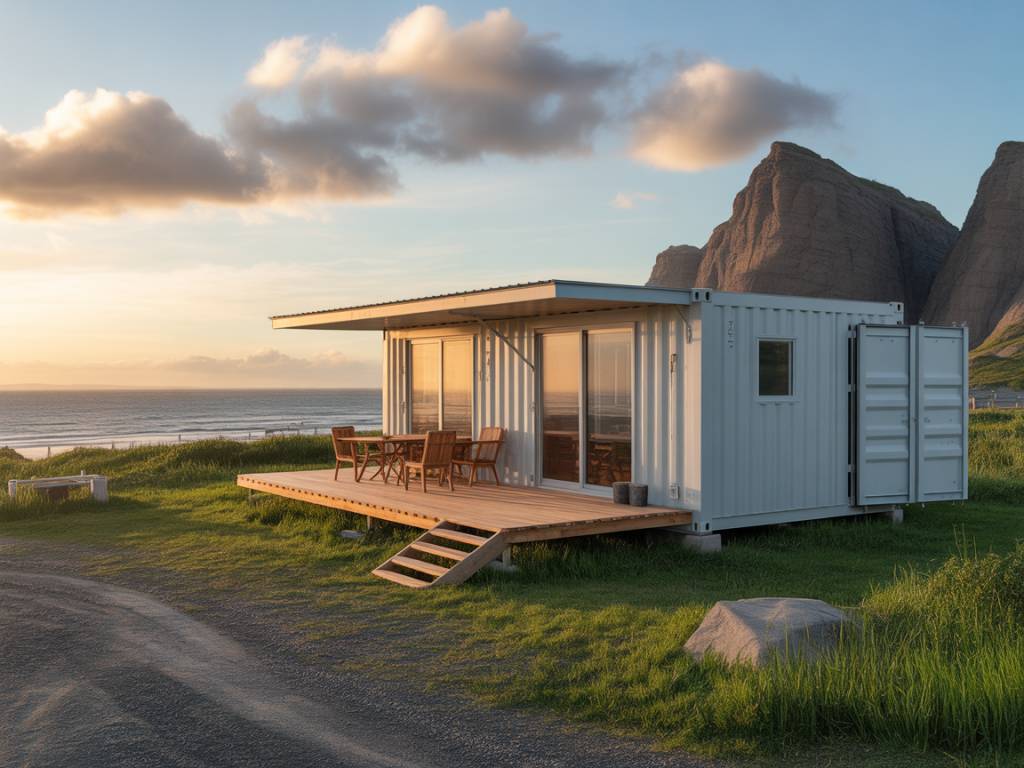
Shipping containers are engineered to cross oceans, pas pour devenir des maisons. Yet more and more projects place them in typhoon corridors, desert plateaus or right on the shoreline. The result : a robust steel box exposed to UV, salt spray, wind-driven rain, condensation and thermal shock that far exceed a typical suburban house.
Weatherproofing is where a container home either becomes a durable asset… or a fast-rusting liability. In extreme climates and coastal locations, the standard “cut, insulate, paint” approach is not enough. You need a strategy that treats the container like what it really is: a thin steel shell with high thermal conductivity and high corrosion risk.
Let’s look at how designers and self-builders can upgrade that shell for wind, water, salt and temperature, with a focus on methods that are technically robust and still realistic on site.
Understand what your climate will really do to the container
Before choosing materials, it’s worth mapping the main stress factors. A 40 ft container in the inland mountains does not age like a 20 ft box on a dune in Florida.
Key loads to quantify:
- Wind and uplift – Coastal zones often see design wind speeds of 40–60 m/s (≈150–215 km/h). A lightly anchored container can slide or even tip, especially when stacked and cut open with large glazed areas.
- Salt and corrosion – In the first 500–1000 m from the shore, chloride deposition accelerates rust. ISO containers are C5 environment candidates under ISO 12944 (very high corrosivity).
- Rain and driving spray – Horizontal rain, spray and micro-leaks will find every poorly sealed penetration. Original container doors and roof corrugations are not designed to stay watertight in a static domestic setting.
- Temperature extremes – Bare steel can reach 70–80°C under intense sun and plunge below 0°C at night. Thermal expansion, contraction and condensation cycles are brutal on coatings and joints.
- Humidity and condensation – A container is effectively a vapour-tight metal box. Without proper hygrothermal design, interior moisture condenses on cold steel skins, especially in cold or humid climates.
Simple but crucial step: pull the relevant wind and corrosion maps (local building code, meteorological services) for your plot. They will drive your decisions on anchoring, coatings and detailing.
Start with the envelope strategy, not with insulation thickness
Many projects begin by asking “How many centimetres of insulation do I need?” On an exposed or coastal site, the more useful starting point is: “Where does the first line of defence sit?”
Three envelope logics are commonly used with containers:
- Directly exposed container shell – Steel remains the outer skin, simply painted and locally insulated from inside. Simple and cheap but high thermal bridges, high solar gain and high corrosion risk in C4–C5 environments.
- Overskin / second envelope – The container becomes structure, and a secondary shell (ventilated cladding on battens, rainscreen, even a second light roof) takes over the weather role. More material, but performance and durability are far better.
- Hybrid – Critical facades (south, windward side, sea-facing elevations) receive a ventilated screen or double roof; less exposed faces keep the container as outer skin.
For extreme or coastal sites, the second option (overskin) has a clear track record: it keeps the steel dry, shaded and ventilated, which dramatically slows corrosion and reduces thermal stress on the structure.
Protecting the roof: from weak point to shield
The factory container roof is thin corrugated steel, designed to shed water for 15–20 years of shipping life, not to support decades of UV on a static house.
To weatherproof it under severe wind and rain, the projects that age best tend to use a “sacrificial” or protective roof:
- Add a lightweight over-roof – Steel purlins or timber framing fixed to container corner castings and/or side rails, supporting:
- Profiled metal sheets with anti-condensation backing, or
- Fibre-cement boards, or
- Standing seam metal, sometimes with integrated PV.
- Create generous overhangs – 60–100 cm eaves drastically reduce the amount of wind-driven rain and direct sun on the container walls and openings.
- Ventilate the roof cavity – A 30–50 mm air gap with soffit inlets and ridge outlets lowers roof temperature and evacuates any infiltrated moisture.
- Detail fixings for uplift – In cyclone zones, every roof panel should be mechanically fixed to the purlins, which in turn are tied to the container frame (corner castings, not just thin roof sheet). Consult local wind uplift tables for spacing.
If an over-roof is truly impossible, a high-build elastomeric or polyurea coating on the original roof can work as a stopgap, but only with meticulous surface preparation (SA 2.5 blast cleaning ideally) and regular inspection.
Wall protection: coatings, claddings and thermal bridges
Walls are where aesthetics and performance meet. On a beach site, the temptation is to keep the “container look” visible. Technically, that’s the least forgiving option.
Let’s compare the main approaches.
- Marine-grade paint on exposed steel
- System: abrasive blast + zinc-rich primer + intermediate epoxy + polyurethane topcoat.
- Performance: with 250–320 µm total dry film, C5 environments can reach 15–25 years to first major maintenance (per ISO 12944), assuming no mechanical damage.
- Limits: every cut, weld and new opening is a potential weak spot; impact damage and micro-cracks are common in domestic use; thermal performance still poor without additional strategies.
- Ventilated cladding on external insulation
- System: structural brackets fixed to container posts/rails, rigid insulation boards (mineral wool, PIR, wood fibre) outside, then ventilated cavity and cladding (metal, fibre-cement, timber, composite).
- Performance: continuous insulation reduces thermal bridges, cavity drains and dries, steel stays close to interior temperature.
- Limits: detailing is more complex; requires careful structural design to avoid overloading container walls and to manage wind suction on the cladding.
- Internal insulation only
- System: spray foam or framed insulation against inside face of steel.
- Performance: acceptable in mild, dry climates; harder to control condensation risks at the steel interface in cold or highly humid contexts.
- Limits: steel remains hot/cold, increasing condensation potential; corrosion can progress unseen behind insulation if any moisture penetrates.
For extreme climates and coastal sites, an externally insulated, ventilated wall is usually the safest long-term option: less condensation risk, less thermal shock, lower roof and wall surface temperatures, and better corrosion control.
Openings: where wind and water will test your detailing
Every cut into the container breaks its original weatherproofing. In a harsh environment, the priority is not maximum glass area, but robust frames, proper flashing and structural reinforcement.
Key practices from projects in cyclone and marine zones:
- Reinforce cut-outs – Treat every opening as a structural modification:
- Weld steel frames (box sections) around large windows and doors, tying into top/bottom rails and corner posts where possible.
- Have an engineer validate the modified load path if stacking containers or creating wide openings.
- Use certified storm-rated joinery – In hurricane-prone regions, choose windows/doors tested to local impact and pressure standards (e.g. Miami-Dade, EN 1627/12210 equivalents).
- Design proper sills and flashings – This is non-negotiable in coastal storms:
- Sloped sills projecting beyond cladding, with drip edges.
- Head flashings tucked behind cladding or siding, not face-fixed only.
- Side flashings (jambs) integrated with WRB (water-resistive barrier) or membrane, lapped shingle-style.
- Limit opening directions on windward facades – Sliding units or inward-opening windows can be safer and more watertight than large outward-opening casements directly facing prevailing storms.
A practical rule: assume seals will eventually age and leak. The geometry (overhangs, sills, flashings, cavity drainage) must ensure that leaked water can exit without reaching insulation or interior finishes.
Corrosion control: see the steel as a system, not just a paint layer
On a coastal site, corrosion is not a distant possibility; it is an active design constraint.
Actions to manage it over the full life of the container home:
- Identify and remove contaminants – Many used containers carry unknown residues in floorboards and on steel. Before any coating:
- Strip original floor if in doubt (often with pesticides or spills).
- Degrease and mechanically clean steel surfaces.
- Treat all welds and cuts – Heat-affected zones and fresh cuts rust faster:
- Grind smooth, clean to bright metal.
- Apply zinc-rich primer immediately, then full paint system.
- Favour cavity ventilation – Behind claddings, under raised floors, in roof voids: stagnant humid air is the enemy. Continuous air paths + insect screens are simple but effective.
- Separate dissimilar metals – If aluminium cladding or stainless fixings meet carbon steel without isolation in a salty environment, galvanic corrosion can appear. Use isolating washers, paints, or compatible metal choices.
- Plan inspection access – Do not entomb all steel in inaccessible closed cavities. Leave access hatches to check critical nodes (corners, junctions, beams supporting decks, etc.) at least every 3–5 years.
In the most aggressive zones (direct spray, docks, offshore platforms), some designers add sacrificial anodes (as on boats), but for housing on land, good coatings plus drying details are usually sufficient.
Foundations and anchoring: keep the box still and dry
Even the best envelope fails if the container moves, settles or stands in water. Extreme weather often increases both uplift and flood risk.
For coastal and high-wind sites, look at foundations through three lenses:
- Anchoring against wind uplift and sliding
- Use steel hold-downs connecting container corner castings to concrete footings or driven piles.
- Dimension anchors based on local code wind speeds and building height/shape, not generic “tiny house” fixings.
- Consider cross-bracing between containers for stacked or bridged assemblies.
- Elevation above splash and flood levels
- In flood or storm-surge zones, raise the lowest steel at least above design flood level (plus freeboard margin set by code).
- Use piers, piles or a framed platform that lets water pass underneath rather than pushing against a solid wall.
- Drainage away from steel
- Grade soil to slope away from perimeter.
- Add perimeter drains where soils are poor.
- Keep at least 150–200 mm clearance between finished ground level and any exposed steel element.
A container on four basic concrete pads can survive in a temperate garden. On an exposed shoreline or mountain ridge, it is a recipe for movement, water pooling and frame distortion that will quickly telegraph into doors, windows and joints.
Moisture, insulation and ventilation: controlling what happens inside the box
From an occupant’s point of view, weatherproofing also means avoiding mouldy corners, dripping windows and swollen finishes. For a steel shell in extreme climates, that comes down to managing vapour, air leakage and temperature gradients.
Some practical design guidelines:
- Prefer continuous insulation layers – Whether inside or outside, aim for as few thermal bridges as possible at ribs, rails and posts. Spray foam can help internally; rigid boards or mineral wool help externally.
- Get dew point calculations done – For cold climates or large temperature swings, ask your designer or engineer to model the wall and roof build-ups (temperature and vapour profiles). This is standard practice in good modular design and avoids condensation trapped at the steel interface.
- Control interior humidity
- Install mechanical ventilation with heat recovery (MVHR/HRV) in cold climates or energy recovery (ERV) in humid-hot climates.
- Target 40–60 % relative humidity indoors whenever possible.
- Seal unintended air leaks, not the whole box – Make the envelope airtight in a controlled way, then ventilate mechanically. Random leaks through junctions simply drive moist air into cavities where it can condense on steel.
- Protect vulnerable materials – Avoid paper-faced gypsum or low-grade MDF directly on cold steel or near potential leak points; prefer cement boards, treated plywood or moisture-resistant gypsum where risk is higher.
A container can be either a condensation trap or a controlled, high-performance envelope. The difference is largely in how vapour, temperature and air change are managed.
Case patterns from coastal and extreme-climate projects
Across recent container-based projects in coastal Portugal, the US Gulf Coast or the North Sea, several recurring patterns emerge.
- Double roof almost every time – Very few long-lived buildings keep the original container roof as the only weather layer. A ventilated over-roof is now almost a standard in serious designs.
- Partial or full external insulation – Especially on sea-facing facades, designers favour ventilated cladding over external insulation to protect the steel and reduce condensation risk.
- Reduced reliance on original container doors – Many projects keep them only as storm shutters, with a proper glazed wall behind, or they disappear entirely from the main façades in favour of high-spec joinery.
- Early corrosion planning – Abrasive blasting, industrial coating systems and rigorous weld treatment are budgeted from day one, not squeezed at the end.
- Hybrid structural logic – The container provides a robust, modular frame, but additional steel or timber structures take over for wide roofs, large terraces and extended canopies to protect the boxes.
These patterns reflect a simple reality: in hard climates, the container is more valuable as a pre-fabricated structural chassis than as a finished exterior skin.
Maintenance: the overlooked component of weatherproof design
A weatherproof container home is not “maintenance-free”. The difference between a building that ages well and one that fails early often comes down to a simple, regular checklist.
At least once a year (and after major storms), plan to:
- Inspect roof surfaces and over-roof fixings for loose fasteners, sealant failure, standing water and coating damage.
- Check all flashings, window sills and door thresholds for cracks, clogged drainage paths or signs of leakage.
- Examine accessible steel surfaces, especially welds, corners and low points, for blistering paint, rust spots or galvanic corrosion signs.
- Clean salt and debris from cladding, gutters, downpipes and ventilation inlets on coastal sites.
- Verify that foundation anchors and hold-downs remain tight and uncorroded.
- Monitor indoor humidity and any signs of mould or condensation, adjusting ventilation use accordingly.
Weatherproofing is not just a set of construction details; it is a strategy that extends into operation. Designing with inspection and repair in mind is part of that strategy.
For owners, architects and builders willing to treat the container as an engineering object rather than a simple box, the payoff is clear: a compact, modular structure that can sit safely on exposed headlands, desert ridges or storm-prone coasts without becoming a maintenance nightmare. The steel can handle the wind; it is up to the envelope design to handle everything else.